
The London Summit: Discussing Human Rights and Forced Labour
Returning to London on 8–9 September 2026, Sustainability LIVE: The London Summit + Awards is a two-day hybrid conference bringing together senior sustainability executives to accelerate climate action, advance ESG strategies and deliver meaningful progress towards net zero.
As sustainability regulations continue to evolve and global supply chains become more complex, organisations are placing greater emphasis on responsible sourcing, ethical business practices and protecting human rights alongside their environmental commitments.
Co-located with Procurement & Supply Chain LIVE: The London Summit + Awards, the event provides a unique opportunity for sustainability, procurement and supply chain leaders to collaborate, share best practice and align climate action with responsible business strategies.
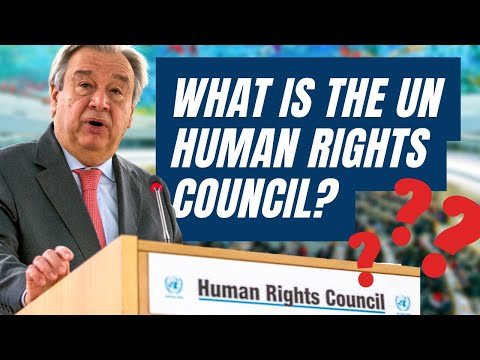
What are human rights?
Human rights are universal rights that belong to every person simply because they are human, regardless of race, sex, nationality, language, religion or any other status.
According to the United Nations (UN), human rights include fundamental freedoms such as the right to life and liberty, freedom from slavery and torture, freedom of opinion and expression, and the rights to work and education.
The UN explains that these rights are protected by international human rights law, which places legal obligations on governments to respect, protect and fulfil the rights of all people without discrimination.
It also states that the international human rights framework, built on key documents such as the UN Charter and the Universal Declaration of Human Rights, has evolved over time to address the needs of specific groups and promote equality around the world.
“The Universal Declaration of Human Rights defines what every person needs to survive and thrive,” says António Guterres, Secretary-General of the UN.
“Human rights, civil, political, economic, social and cultural, are inalienable, indivisible and interdependent.
“Together with civil society and governments, we deliver food and provide shelter; support education and elections; clear mines; defend the environment; empower women and strive for peace.
“Our rights should never take second place to profit or power.
“Let us unite to protect them, for the dignity and freedom of all.”
The World Health Organization (WHO) states that human rights include the right to the highest attainable standard of physical and mental health.
It explains that health-related rights are legally binding commitments, requiring countries to provide equitable access to healthcare and address the underlying causes of inequality, including poverty and discrimination.
The WHO also emphasises that the right to health is closely linked to other human rights, such as the rights to education, housing and food. It says governments must adopt a human rights-based approach to health in order to meet their international obligations.
Sustainability LIVE: The London Summit + Awards
With more than 1,000 in-person attendees, Sustainability LIVE: The London Summit + Awards provides the insights, connections and practical solutions organisations need to accelerate progress towards net zero while navigating an increasingly complex sustainability landscape.
Across two days, the programme features more than 50 expert speakers, 10 core content themes and four executive workshops, offering strategic and practical guidance on climate disclosure, circular economy, innovation, stakeholder engagement and embedding sustainability across the organisation.
Co-located with Procurement & Supply Chain LIVE: The London Summit + Awards, the event creates valuable opportunities for cross-functional collaboration, enabling sustainability, procurement and supply chain leaders to align climate action with sourcing and operational strategies that deliver measurable impact.
Discussing the future of human rights & forced labour
Taking place on 8 September 2026 from 14:15–15:00 BST on the Sustainability Stage, The Future of Human Rights & Forced Labour panel is set to explore how growing human rights expectations are reshaping corporate responsibility across global supply chains.
As regulation intensifies and supply chains become increasingly interconnected, the panel will examine why addressing human rights risks and forced labour is now a strategic imperative rather than simply a compliance exercise.
Bringing together business leaders, policymakers and civil society representatives, the discussion aims to explore emerging legislation, data-driven due diligence, worker-centred approaches and responsible sourcing.
Delegates can gain practical insights into strengthening transparency, protecting workers and building more resilient, ethical supply chains that support long-term business success.
Company portals
Executives
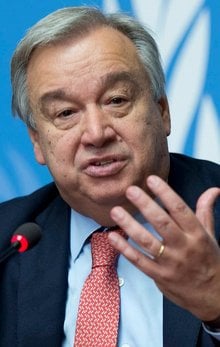
António Guterres
Secretary General