
UN Secretary-General’s Exit-Plan from Fossil Fuels
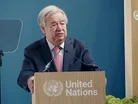
The world is undergoing two key crises – but United Nations Secretary-General António Guterres believes that this tale of two crises can be turned into a story of resolve.
In a room full of world leaders in the heart of London, the Secretary-General took to the stage for his Special Address on the Global Response to the Climate and Energy Crisis.
As part of a London Climate Action Week taking place in the middle of a heatwave that expects to get to record-breaking temperatures throughout the week, the delegates – comprising of ambassadors, royalty, politicians, business leaders and media – were unable to ignore the realities of climate change in 2026 despite the Secretary-General’s message of hope.
‘Crisis brings clarity’
The climate crisis and the energy crisis are realities around the world. While the climate crisis has slowly become apparent and is now evident through disruptions to food and water systems, extreme weather, global temperate rise and much more, the energy crisis has spiked due to the recent conflict in the Middle East.
“Crisis brings clarity,” António says. “And here in London – the city of Dickens – it is clear that our world is facing a Tale of Two Crises.

“A climate crisis pushing us deeper toward higher temperatures and closer to catastrophic tipping points.
“And an energy crisis exposing the folly of a world hooked on hydrocarbons.
“On the surface, these crises may seem separate. But they share the same destructive force – fossil fuels.
“And they demand the same answer – a fast, fair transition to clean energy, and a surge in adaptation, resilience and climate justice for those already facing climate harm.”
The climate crisis
The climate crisis is at the centre of many conversations throughout London Climate Action Week
“Climate chaos is accelerating before our eyes,” António says.
“We have just lived through the 11hottest years ever recorded. Climate disasters are becoming more frequent, more destructive and more costly.
“And the World Meteorological Organization has warned we ain’t seen nothing yet.”
The examples are fast flowing – El Niño, the destruction of the coral reefs, the accelerating loss of ice sheets in Greenland and the West Antarctic, the weakening of major ocean circulation systems and parts of the Amazon rainforest shifting toward savanna-like conditions to name a few.
“The task before us is to strictly limit the overshoot, shorten its duration and bring
temperatures down below 1.5 degrees Celsius as fast as possible,” António urges.
“Every fraction of a degree matters. Every moment counts. Because the higher and longer the overshoot, the greater the risk of crossing planetary tipping points that trigger irreversible change.”
The energy crisis
The energy crisis is working alongside the climate crisis, and has become an urgent reality to many around the world.
“Conflict in the Middle East has unleashed the mother of all energy shocks,” António says.
“The International Energy Agency tells us its scale rivals the oil upheavals of the
1970s and the turmoil followed by the Russian invasion of Ukraine combined.”
The energy crisis has sent shocks rippling throughout other systems that will have long-lasting impacts, even if a peace agreement is reached.
The Earth’s tipping points are like objects in a car mirror: they are far closer than they appear
Shifting the model
While the dual crises both present significant potential for destruction, depletion and impact on communities around the world, there is a solution.
“These twin crises have once again exposed the limits of an outdated model of development,” António explains.
The model, he says, is powered on fossil fuels, abuse of nature, creating wealth while deepening inequality and fueling insecurity.
“A model in which those who did the least to cause these crises pay the highest price. The lesson is clear – this model has no future.”
This has already been recognised internationally through the UN Sustainable Development Goals, which António believes need seeing through to full implementation.
Seven steps to energy independence
António outlined seven steps to “make a clean break” from the fossil fuel dependence that is causing the climate and energy crises:
- “We must act with far greater urgency to strictly limit the magnitude and duration of any overshoot beyond 1.5 degrees.” The G20, which is responsible for around 80% of global emissions, must take the lead the support net zero by 2050, and every major emitter must accelerate action. He also announced the global Call to Action on Methane, which is responsible for around one third of global warming and is 80 times more powerful than CO₂.
- “We must address today’s energy crisis without deepening dependence on the fuels driving it.” A key theme of the address was reduction of reliance on fossil fuels and growth of renewable energy.
- “As demand for energy continues to rise, we must confront one of its fastest growing sources: AI data centres.” António proposes the AI Environmental Transparency Initiative. “I am calling on every major AI company to measure and publicly disclose the full environmental impact of its systems – carbon, water and land footprints – and to commit to power every data centre with renewable energy by 2030.”
- “We must deliver a just transition.” This involves a shared, practical effort that doesn't leave communities behind or leave economies at risk.
- “We must do far more to protect people and communities from the here-and-now effects of climate chaos.” The risks of climate change can compound and cascade into a food crisis, debt crisis or public health emergency and straining systems that need support and preparation.
- “All of this requires finance at the scale, speed and fairness that both crises demand.” Global finance isn’t being mobilised towards opportunity. António gives the example of Africa – while the continent is home to 60% of the world’s solar resources , it receives only 2% of global clean energy investment – and still more than 600 million Africans lack access to electricity.
- “We must protect science – and truth itself.”
The opportunity – and responsibility
The speech landed with a stark but ultimately constructive message: the climate and energy crises are not parallel challenges to be managed separately, but symptoms of the same systemic failure.
Clean energy as a solution is no longer a distant ambition; it is an economic, technological and geopolitical reality already reshaping markets and redefining security. The real question is no longer whether the transition will happen, but whether it will be fast enough – and fair enough – to avoid the most dangerous consequences.
For businesses, policymakers and investors alike, the implications are immediate. Delaying the transition risks locking in stranded assets, widening inequality and missing out on the growth engine of the 21st century. Accelerating it, by contrast, offers a pathway to resilience, stability and shared prosperity.
“We have the enormous opportunity – and responsibility – to turn this Tale of Two Crises into a single story of resolve, fairness and shared progress,” António concludes.
“We can finally turn the page on fossil fuels – and write a future powered by renewables and rooted in climate justice.
“This is our moment of choice. Our moment of truth. Our moment of opportunity. Let’s seize it.”
Company portals

Executives
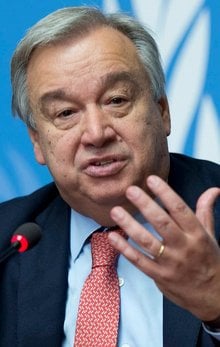
António Guterres
Secretary General