What Does the Future Hold for Supply Chain Sustainability?

Amid growing geopolitical uncertainties, sustainability has become a main focus within global supply chains.
Sustainability can be positioned as a key indicator of profitability, as well as building resilience throughout the value chain.
With more consumers actively choosing brands with clear ESG priorities, sustainability and supply chain executives must focus on traceability and reporting systems.
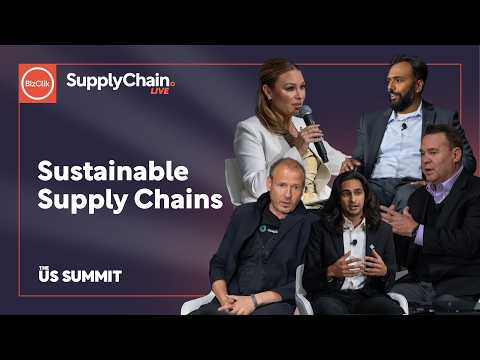
At Sustainability LIVE: The Leadership Summit at London Climate Action Week, leaders came together for a panel on The Future of Sustainable Supply Chains.
This panel discussion explored how organisations are improving transparency, strengthening supplier engagement and reducing environmental impact across their global value chains.
The challenges of supply chain sustainability
The discussion began with each leader outlining the challenges and opportunities of embedding sustainability within their own industries’ supply chains.
Anna Richardson, Global Head of Supply Chain Sustainability & Diversity at HSBC, said: “I see research in the banking sector and the collaboration there has been challenging.”
Amanda Martins, Head of Sustainability at Atlassian Williams Racing, added: “The burning of the fuel while racing is always what first comes to mind, but actually, that’s not even remotely the biggest emission factor.
“That would definitely be the supply chain – the whole infrastructure around making the car possible to build.
“We are now in the phase of submitting our targets to the SBTi, which is a big challenge in a sport like ours.”
Sustainable fuels for customers and clients
The panel also touched on the use of sustainable aviation fuel (SAF) to decarbonise business travel and reduce value chain emissions.
Fiona said: “It’s critical for us to be able to scale our SAF use.
“Last year, we were at 0.2% SAF as part of our fuel mix, but with our partners, we were able to get to 1.2% over the last 12 months.
“There’s obviously still a long way to go to get to 10% by 2030, but those catalytic partnerships are what enable us to keep sourcing more and more SAF.”
Øistein spoke about the dilemma of having more sustainable fuels as a more expensive option for customers.
“As long as the customers don’t need to do that, most of them will not,” he said.
“For consumers, when you’re on holiday, you’re not going to pay extra for the use of biofuel. That says something about the dynamics of that and why it’s not that easy to switch.
“That’s why we support strong regulations, then we are able to handle that ourselves in a circular system.”
Scaling sustainability across supply chains
Throughout global supply chains, there are many opportunities to scale climate strategies, with a focus on collaboration with other key players in the supply chain.
Katherine Pickus, Chief Sustainability Officer at ADM, said: “Our programme right now is benefitting from incentive-based policy.
“We are having money go from the US Department of Agriculture to our farmers to help those who otherwise wouldn’t be able to access our programme. This helps scale what we are trying to do more rapidly.
“That’s good for farmers. I think that there’s a huge opportunity to look for the private sector and private capital in a lot of these contexts, they could attract a quicker uptake.”
Anna also discussed the impact that AI could have on sustainable supply chains, especially in her own company.
“It is an enabler and catalyst for net zero if used responsibly," she said.
Company portals





Executives

Amanda Martins
Head of Sustainability

Anna Richardson
Global Head of Supply Chain Sustainability & Diversity

Fiona Messent
Chief Sustainability Officer
Katherine F. Pickus
Chief Sustainability Officer
Øistein Jensen
CSO