Sustainability LIVE: Net Zero – BT’s Sustainability Strategy
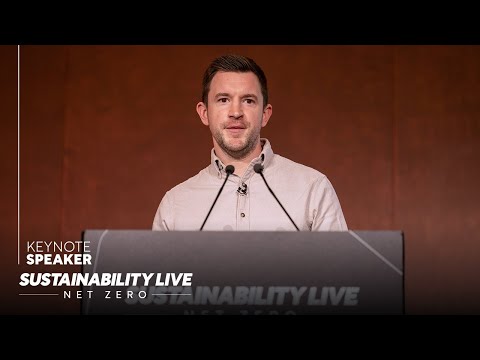
At Sustainability LIVE: Net Zero, Matt Manning, Head of Circularity & Net Zero at BT Group took to the stage to share the telecom giant’s approach to net zero, circularity and supply chain transformation.
Speaking to a live audience and addressing follow-up questions from experts and peers, Matt unpacked BT’s journey towards decarbonisation, delving into energy optimisation, the switch to electric vehicles and industry collaboration.
BT’s route to net zero
Opening with a reference to Maslow’s hierarchy of needs and the everyday importance of internet access, Matt positioned BT’s sustainability efforts as critical to modern life.
With 30 million customers and more than 200 million devices connected last year alone, the telecommunication’s energy use is significant. However, Matt highlighted that even as data traffic increased by 600% between 2015 and 2020, energy consumption only rose by 5%, showcasing gains in efficiency.
A major contributor to these gains was the switch-off of BT’s 3G network.
"That represented about 2% of data traffic, but 35% of our energy consumption," Matt explained, reinforcing the efficiency benefits of transitioning to 4G and 5G.
Additionally, BT is accelerating the move from copper to full fibre networks, further reducing operational emissions.
BT’s climate targets are set for March 2031 for operational net zero and March 2041 for its entire value chain.
"We set our first carbon target back in 1992 and our current targets cut scope three upstream value chain emissions by 40% by 2031," he said.
Collaboration, fleets and buildings
Matt described BT’s 30,000-strong vehicle fleet as one of the UK’s largest.
With 5,000 EVs already on the road and a new order for 3,500 more, BT is moving fast, but challenges remain. Some vehicles operate in remote areas or carry heavy loads, making full electrification complex.
BT has rolled out a three-tier charging strategy – home, depot and public – and collaborates with others, including First Bus, to maximise infrastructure use.
Decarbonising BT’s physical estate is also in progress.
"We have about 6,000 exchanges. As we rationalise from copper to fibre, that’ll go down to about 1,500," he said.
This reduction translates to fewer buildings needing heating and cooling. BT is also consolidating office spaces, replacing older, inefficient buildings with gas-free hubs.
When it comes to energy sourcing, BT now has a power purchase agreement (PPA) that covers around 25% of its energy use. The company also actively explores onsite renewable generation and has improved energy efficiency across its network.
Innovations like sleep cell technology – turning off mobile towers during low-usage periods – have saved 17m kWh annually.
Supply chains, circularity and stakeholder buy-in
Turning to scope three emissions, Matt highlighted the complexity of BT’s supply chain. Of 8,000 suppliers, BT focuses engagement on the top 200, which represent just under 80% of emissions.
“We ask them to disclose through CDP. It’s a really consistent platform,” Matt explained.
Working through trade bodies like the Joint Association for CSR, BT collaborates with 29 global telcos to engage suppliers jointly, share product carbon data and align sustainability asks.
“We’re shifting from spend-based modelling to product-level footprints,” he noted.
On circularity, BT has implemented product leasing, refurbishment and reuse across customer premises equipment (CPE).
Since 2020, routers are leased to customers and must be returned, enabling reuse and recycling.
"We treat the refurb stuff the same as new," Matt said, noting an average saving of £25m (US$33m) and 40,000 tonnes of CO₂ annually from refurbishment.
BT has also upgraded device trade-in and repair programmes.
"Last year, about 166,000 phones were traded in,” he shared, with repaired devices now re-entering circulation. Product design has also shifted, with hubs made from 95% recycled plastic and single-use plastics removed from packaging.
During his session, Matt responded to questions on stakeholder engagement, noting the importance of using financial language to win over internal buy-in: "If that’s the language that gets it over the line, then that’s great.”
He also touched on the challenge of carbon neutralisation, discussing internal plans to socialise the cost through internal pricing models.
Summing up BT’s approach, Matt described it as holistic and evolving, grounded in long-term goals, yet pragmatic and collaborative in implementation.
“It’s a pleasure that we’re able to all work collaboratively together to kind of address some of these common issues,” he concluded.
Essential diary dates for 2025
Discover the essential diary dates for Sustainability Magazine and its sister publications – Procurement Magazine and Supply Chain Digital.
To follow Sustainability LIVE on LinkedIn, click here.
To enter for the Global Sustainability & ESG Awards, click here.
- Sustainability LIVE Chicago | 28-29 May
- Procurement LIVE Chicago | 28-29 May
- Supply Chain LIVE Chicago | 28-29 May
- Sustainability LIVE London | 9-10 September
- The Global Sustainability & ESG Awards | 10 September
- Sustainability LIVE: Climate Week NYC | 22 September
- Sustainability LIVE: COP 30 Brazil | 11 November
Explore the latest edition of Sustainability Magazine and be part of the conversation at our global conference series, Sustainability LIVE.
Discover all our upcoming events and secure your tickets today.
Sustainability Magazine is a BizClik brand