Sustainability LIVE Q&A: Timothy Flacke, Commonwealth
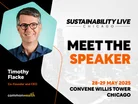
Heading to Chicago in just over a month for a co-located event alongside Procurement & Supply Chain LIVE, Sustainability LIVE Chicago will take place on 28 and 29 May 2025.
With one ticket unlocking access to all stages, the co-located event will provide an exclusive opportunity to network and collaborate at the intersection of sustainability, procurement and supply chain.
Across the two-day event, attendees can look forward to a range of keynotes, panel discussions, fireside chats and workshops to equip them with the knowledge to stay ahead of the curve in these dynamic industries.
To secure your place in Chicago, click here.

Timothy Flacke, Co-Founder and CEO at Commonwealth
For 30 years, Timothy has focused on solutions that help workers and families in the US become more financially secure.
Under his leadership, Commonwealth has grown from a start-up social venture into a national nonprofit that builds financial security and opportunity for underserved people living on low and moderate incomes through innovation and partnerships.
Commonwealth collaborates with leading financial service firms, employers, benefit providers and government agencies, and is supported by some of the world’s most respected philanthropies.
Timothy is a frequent speaker to banking, human resources and fintech groups, and provides expert commentary and perspective in the media on broadening financial security.
Timothy and his teams have pioneered the use of prizes and gamification to encourage savings, and their efforts have repeatedly impacted the federal tax code and spawned new financial products and public policies that have resulted in nearly US$8bn saved by more than two million households.
He holds a Master’s in Public Policy degree from the John F. Kennedy School of Government at Harvard University and a Bachelor of Arts in Philosophy from Boston College.
Here we speak to Timothy ahead of Sustainability LIVE Chicago where he will take part in a fireside chat.
What inspired you to get involved in the event?
Our mission at Commonwealth is to create a stronger and more prosperous society that advances financial security and opportunity for each of us. If you’re living in a state of economic uncertainty, your ability to make sustainable change is challenged. Sustainability and financial stability are inextricably linked.
Sustainability requires both a short-term focus and a long-term mindset. Yet financial instability breeds just the opposite. We know that broad financial instability undermines households’ ability to focus on the long term.
When your basic needs for physical survival and safety are threatened, as Maslow prioritised them, your focus understandably is on the present. Yet financial security, through ownership and assets, for instance, quite literally invests us in the future.
Data from Deloitte’s Sustainable Actions Index suggests “personal economic conditions profoundly shape the breadth and depth of sustainable behaviours.”
This data makes clear that this isn’t because people living on less are less concerned about addressing climate change and environmental issues, but as the report notes, “the ‘sustainable’ choice is no choice at all.”
But it also tells us that climate action and equity can positively reinforce one another. So that’s where we start. We know from our own research that climate change, for instance, is having a profound financial impact on workers earning low and moderate incomes, who are disproportionately Black, Latin and women.
It’s putting an additional financial burden on those with the fewest resources to manage these financial and life stressors. While the Occupational Safety and Health Administration (OSHA) traditionally focuses on workers’ physical security, the impact of weather-related events on workers’ financial security requires equal attention.
Our research, which aligns with a growing body of work demonstrating that climate change is adding further financial stress to the most vulnerable workers, makes a compelling case for employers and other institutions to consider climate initiatives that address these concerns alongside other sustainability efforts, and create pathways to mitigate the financial impact of extreme or unusual weather events on the short- and long-term financial security of their workforces.
Provide an overview of what your fireside chat will focus on.
I’ll be discussing the role that employers can play in helping workers who are feeling the increasing financial burden imposed by climate-related incidents, particularly those earning low to moderate incomes – and how that ties into workers’ ability to live and act sustainably.
I think we’ll see more workers looking to their employers to help mitigate the financial effects of extreme or unusual weather. In our research, 83% of workers reported wanting an expanded employer response. Over half of workers (95%) said they would feel relieved, happy, or satisfied if their employer helped them if something were to happen due to unusual or extreme weather.
I’ll also highlight innovative workplace benefits that can help address and mitigate this financial strain and support the financial well-being and resilience of all workers.
What do you hope to achieve through the event?
I hope to demonstrate that employers are well-positioned to play a pivotal role in helping workers respond to climate-related crises and to help mitigate the financial pain and disruption these events cause, both for their employees and their businesses.
In 2023, the US experienced 28 weather and climate disasters, totalling at least US$92.9bn. However, to get a full picture, we need to follow the financial impact on individual workers and the subsequent effect on the bottom lines for businesses.
According to the International Labour Organisation, more than 70% of the global workforce is exposed to climate-related risks.
A 2020 report indicates that the US loses an average of US$100bn a year due to heat-induced declines in labour productivity. In 2021, employers lost more than 2.5 billion hours of labour across agriculture, construction, manufacturing and service sectors due to heat exposure.
These economic losses ripple through the workforce: Shifts in work schedules, reduced hours or workplace closures can result in job loss and reduced financial stability. This can trigger the potential loss of housing security, increased financial stress or the inability to access reliable transportation.
Employers have a direct stake in the financial stability and resilience of their workforce. There is a strong business case for helping workers manage, avoid and prepare for weather disruptions.
There are other clear business benefits as well. Flexibility from employers is shown to boost satisfaction and morale and companies that make these accommodations will find it easier to retain top talent.
According to the EY 2022 Sustainable Value Study, 69% of companies with climate initiatives also reported capturing higher financial value than expected on measures such as revenue growth and earnings.
What emerging trends do you believe will shape the future of sustainability over the next decade?
The impact of extreme weather will continue to reverberate across the economy, affecting employers and communities across the board. Action by employers and other institutions will be needed to ensure that climate change does not further widen racial and gender wealth gaps.
Climate change-related employee benefits are among the top offerings HR leaders will need to consider in the coming years.
While several companies provide climate-related benefits to address these impacts, these offerings are often focused on the needs of white-collar jobs, with fewer options for workers earning low-to-moderate incomes.
This presents an opportunity for employers to take the lead in tackling the financial impacts of climate change on workers living on LMI by providing climate-related workplace benefits.
Although wages are critical for worker financial security, they are insufficient on their own. There is a need for companies, particularly those employing lower-wage workers, to design benefits that best support their employees impacted by climate-related weather events.
These offerings have the potential to provide a safety net for vulnerable workers while also providing business benefits.
For instance, emergency savings accounts allow employees to set aside a certain amount of money in case of financial shocks or emergencies. Employers can offer options such as automatic enrollment through payroll deductions or contribute matches to incentivise participation.
Other benefits might include climate-related leave policies, flexible scheduling, emergency relief funds and parametric insurance, which provides affordable, rapid-response protection for predefined events.
Workers also believe financial institutions and the government have an important role to play here. While only a handful of workers have received support from financial institutions after experiencing extreme or unusual weather, 23% feel they should be providing aid.
Meanwhile, 73% of workers surveyed say the government also has a role to play in supporting those impacted by climate change. As climate-related incidents increase, we may see more movement in these sectors.
NEW Innovation Zone
Sustainability LIVE Chicago is elevating its impact and global relevance with the launch of a brand-new Innovation Zone – designed to spotlight the most exciting and transformative technologies driving sustainability forward.
Across two days, this will host a series of focused 15-minute technology pitches, giving pioneering startups, scaleups and solution providers the chance to present their innovations to a high-calibre audience of sustainability leaders, investors and C-suite executives.
This new space will highlight practical solutions that deliver measurable results and drive the sustainability movement forward.
Networking opportunities
Beyond insights and trends, Procurement & Supply Chain LIVE Chicago is a unique opportunity to network with industry experts and peers across the intersection of sustainability, procurement and supply chain.
Join us in Chicago and take part in this transformative journey. Discover how sustainability, procurement and supply chain can work together to achieve sustainable development.
Don’t miss out on your chance to attend Sustainability LIVE Chicago – Secure 2 for 1 entry on tickets NOW!
Essential diary dates for 2025
Discover the essential diary dates for Sustainability Magazine and its sister publications – Procurement Magazine and Supply Chain Digital.
To follow Sustainability LIVE on LinkedIn, click here.
To enter for the Global Sustainability & ESG Awards, click here.
- Sustainability LIVE Chicago | 28-29 May
- Procurement LIVE Chicago | 28-29 May
- Supply Chain LIVE Chicago | 28-29 May
- Sustainability LIVE London | 9-10 September
- The Global Sustainability & ESG Awards | 10 September
- Sustainability LIVE: Climate Week NYC | 22 September
- Sustainability LIVE: COP 30 Brazil | 11 November
Explore the latest edition of Sustainability Magazine and be part of the conversation at our global conference series, Sustainability LIVE.
Discover all our upcoming events and secure your tickets today.
Sustainability Magazine is a BizClik brand