
NYCEDC’s Climate Strategy: How to Build a Green Future

The New York City Economic Development Corporation (NYCEDC) has unveiled a sweeping vision for sustainability.
NYCEDC’s Impact report underscores the city’s ambition to become a global capital of climate innovation.
Through strategic investment, cross-sector collaboration and community engagement, NYCEDC’s work demonstrates how cities can advance environmental progress while creating jobs and building resilience.

Driving a green economy
In February 2024, NYCEDC and Mayor Eric Adams launched the Green Economy Action Plan (GEAP).
The GEAP is a comprehensive roadmap to grow sectors that combat climate change, diversify the economy and equip New Yorkers with the skills needed for nearly 400,000 projected green-collar jobs by 2040.
A cornerstone of this plan is the newly established Green Economy Advisory Council, a diverse group of industry stakeholders tasked with advising on NYCEDC’s commitments and ensuring efforts remain equitable and impactful.
“The sheer scale of milestones reached in the year since announcing the Green Economy Action Plan speaks volumes to the Adams Administration's priority to establishing New York City as a global hub for sustainable innovation,” says Andrew Kimball, NYCEDC President & CEO.

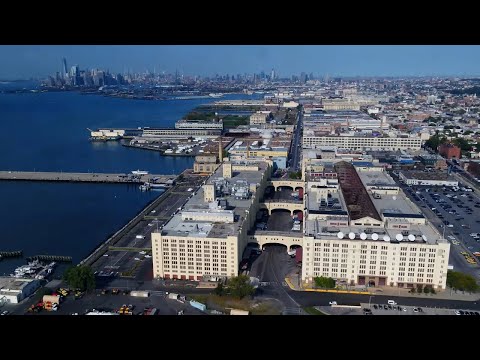
“From the creation of the Climate Innovation Hub at the Brooklyn Army Terminal (BAT), to the groundbreaking of the nation's largest dedicated offshore wind port at the South Brooklyn Marine Terminal (SBMT), NYCEDC is driving the city's green transformation while ensuring that this massive economic opportunity benefits all New Yorkers.”
Backed by a request for proposals worth up to US$100m, this state-of-the-art facility will support startups in developing, piloting and commercialising clean technologies.
Located within a modern manufacturing campus in Sunset Park, the hub also prioritises workforce development — providing local residents with direct access to the city’s growing innovative green ecosystem.
The hub builds on the momentum of Pilots at BAT, a programme enabling climate tech firms to test solutions in real-world conditions.
One company, Enertiv, is already using the site’s infrastructure to deliver granular insights into electricity usage — proving the value of live demonstration spaces for sustainable innovation.
To further support low-carbon infrastructure, NYCEDC launched the NYC Mass Timber Studio in 2024.
This technical assistance programme helps developers use mass timber, a renewable, low-emission material, across active construction projects.
Complementing this, NYCEDC published Clean and Circular: Design and Construction Guidelines, a new resource to help reduce waste and embodied carbon across the built environment.
Resilient infrastructure and transportation
Electrification is a major priority for NYCEDC, driving projects such as New York City’s largest public EV charging station near JFK Airport.
Developed by Wildflower, the facility will initially offer 65 EV charging stations, enabling more than 1,000 vehicles to charge annually and avoiding up to 78,000 metric tonnes of CO₂ emissions by 2040.
Efforts to decarbonise the city’s logistics sector are also underway at Hunts Point, where a federally funded, freight-focused EV charging depot will help transition distribution operations to zero-emission alternatives.
NYCEDC is also prioritising climate resilience, supporting the Battery Coastal Resilience project (BCRP), a US$200m effort to protect Lower Manhattan against sea-level rise and flooding.
Similar to the BCRP, a new flood wall at Metropolitan Hospital in East Harlem is also helping to safeguard essential services during extreme weather events.
Transforming economies
In Sunset Park, the SBMT is being transformed into a world-class offshore wind port, thanks to more than US$1bn in private investment from Equinor.
Once operational, the site will produce 810MW of clean energy, enough to power 500,000 homes, while creating at least 1,000 construction jobs.
Across the harbour, the SBMT is also undergoing a similar transition, with US$164m in federal funding secured in 2024 helping NYCEDC lay the groundwork for a future port that is all-electric, mixed-use and community-serving.
This vision is reinforced by the Harbor Climate Collaborative, an alliance between NYCEDC, The Brooklyn Navy Yard and The Trust for Governors Island.
The group is investing US$725m to develop six million square feet of climate research, training and innovation space across connected harbour sites.
Together, the group will create 5,000 permanent jobs, train 2,100 students and generate an estimated US$55bn in long-term economic impact.
NYC's climate future
“Being part of the Founder Fellowship gave us opportunities to engage more like-minded civic leaders, who are actively working to build more equitable cities,” says Tiasia O’Brien, President and CEO of Co:census.
Tiasia reflects on NYCEDC’s commitment to ensure that the transition to a green economy is inclusive and community-focused.
This extends to the financial tools NYCEDC uses to drive equity.
Through the NYC Catalyst Fund, more than half of the US$40m impact investment pool has now been deployed — including a milestone investment in the Open Opportunity Fund.
“Open Opportunity Fund’s work to invest in Black and Latino tech founders exemplifies the positive social and financial impact the NYC Catalyst Fund was created to support,” says Adolfo Carrión Jr, Deputy Mayor for Housing, Economic Development and Workforce.
“Congratulations to Open Opportunity Fund on their selection for this investment and to the NYCEDC team for reaching this exciting milestone of deploying over half of the US$40 million NYC Catalyst Fund.”
NYCEDC’s 2024 efforts position New York not only as a hub of green job creation but as a city redefining urban sustainability through bold, interconnected strategies.
With public and private sectors aligned and innovation at the core, NYC is well on its way to becoming a global capital of climate innovation.
Explore the latest edition of Sustainability Magazine and be part of the conversation at our global conference series, Sustainability LIVE.
Discover all our upcoming events and secure your tickets today.
Sustainability Magazine is a BizClik brand