
Microsoft's SPARROW: Tracking & Mitigating Biodiversity Loss
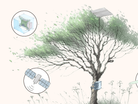
One of the greatest challenges facing our world today is the alarming decline in global biodiversity.
Over the last half-century, we've seen vertebrate populations plummet, with an average decrease of almost 70% since 1970, according to the WWF's Living Planet Report.
As many species hover on the edge of extinction, the need to harness every possible resource to halt and reverse this trend is growing more and more urgent.
In this struggle, the importance of precise measurement should not be understated. Quantifiable data is vital to assess the effectiveness of conservation strategies that aim to preserve and restore our ecosystems.
However, traditional methods of data collection often falter due to logistical challenges, especially within conservation efforts spread across remote and largely inaccessible areas.

High-tech conservation
Addressing these challenges, Microsoft’s AI for Good Lab has developed an innovative solution named Solar-Powered Acoustic and Remote Recording Observation Watch, otherwise known as SPARROW.
This tool leverages AI to gather data efficiently from the most secluded parts of the world directly into the cloud. SPARROW stands out as an AI-enabled edge computing device designed for autonomous operation in harsh environments.
It is solar-powered and equipped with various sensors that capture essential biodiversity data. This includes inputs from camera traps, acoustic monitors, and environmental sensors that gather crucial information about remote ecosystems.
The device leverages Microsoft’s PyTorch Wildlife, an open-source platform. This platform enables conservation scientists to use AI tools efficiently, simplifying the development, application, and sharing of deep learning models geared towards wildlife conservation.
Data processing through SPARROW occurs on low-energy edge GPUs. The processed data is transmitted via low-Earth orbit satellites to the cloud, where researchers can access actionable, real-time insights.
“Developed by our AI for Good Lab, SPARROW is designed to protect the Earth’s biodiversity by providing real-time insights into remote ecosystems and supporting researchers in critical preservation efforts,” says Microsoft’s Chief Sustainability Officer Melanie Nakagawa.
The global impact of open-source innovation
Microsoft has made SPARROW’s technology, including software, hardware and 3D-printable designs, freely available.
This empowers conservationists, research teams and citizen scientists to custom-build and deploy their own versions of SPARROW to suit all manner of environmental monitoring needs.
“This approach empowers research teams, NGOs, and citizen scientists to build, deploy and adapt their own SPARROW devices," shares Juan Lavista Ferres, Microsoft’s Chief Data Scientist.
In early 2025, Microsoft is expected to roll out SPARROW devices across key field sites in North and South America, including Colombia. This deployment is part of Project Guacamaya, a collaborative effort focused on using AI to monitor deforestation and biodiversity loss in the Amazon.
“We hope to help researchers measure our world more accurately, intervene more effectively, and ultimately preserve the incredible web of life that sustains us all," Juan states, indicating the project’s mission to pioneer a new era of ecological conservation through technological innovation.
With such initiatives, the potential to transform conservation strategies on a global scale is immense, combining the powers of AI with the ethos of community and collaboration.
“With SPARROW, we’re empowering a global community of researchers and scientists to transform data collection from some of the most remote and difficult-to-reach regions by eliminating the need to physically retrieve data.”
Explore the latest edition of Sustainability Magazine and be part of the conversation at our global conference series, Sustainability LIVE .
Discover all our upcoming events and secure your tickets today.
Sustainability Magazine is a BizClik brand
