Will Climate Change Increase the Price of Your Starbucks?
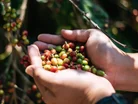
Prices in the global coffee market are on the rise, driven by a combination of factors including adverse weather conditions, tight supply chains, and evolving production trends.
In a recent report by the World Bank's Commodity Markets Outlook, there's talk of an 18% increase in their beverage price index, much of it fuelled by significant jumps in coffee and cocoa prices.
After a spike of 58% in the price index during 2024, forecasts suggest a decline of 9% in 2025 and an additional drop of 3% in 2026 as production begins to stabilise.
Behind the coffee price spike
On the front lines, coffee producers and roasters are scrambling to manage the ongoing volatility in market prices.
BIGGBY COFFEE, under the resilience and forward-thinking leadership of Co-Founder & CEO Bob Fish, seems unperturbed.
“BIGGBY COFFEE will be fine, we have understood that this moment was inevitable,” Bob explains.
“Our model will not only survive but thrive. Hint, you have to deeply care about your supply chain and the people in it, from producer to end user.
“We will be 30 years old in March. Four coffee waves, the financial crisis of 08, COVID and multiple competitors. We always persevere.”
This confidence is in sharp contrast to the overall industry sentiment, especially given that arabica coffee prices have surged by 13% recently, marking a year-over-year increase of over 60%.
Meanwhile, robusta coffee prices aren't far behind with a 5% increase, effectively doubling from the previous year.
Even as global coffee production is projected to rise slightly from 169.8 million bags in 2024 to 172.4 million bags in 2025, it still falls short of the levels seen in the 2020-21 period.
Arabica prices are expected to decline by 8% in 2025 before they stabilise in 2026, with robusta prices expected to fall by 7% in 2026.
As a result, major retailers are trying to reassure their stakeholders.
“Our year-over-year coffee price impact was minimal,” Starbucks CFO Rachel Ruggeri told investors.
Challenges across the global supply chain
Brazil remains a central figure in the global coffee narrative, contributing 38% to the world's coffee output as noted by Conab, Brazil's national food supply agency.
However, production forecasts for 2025 show a decline of 4.4% to 51.8 million bags due to detrimental weather conditions such as severe drought and delayed rainfall.
Even though robusta outputs are expected to rise by 17% due to more favourable weather, the overall picture remains tight.
Additionally, speculative activities in coffee futures have injected further uncertainty, with ICE Futures US New York arabica contracts hitting record highs early in 2025, a stark rise from the previous year.

The long-term implication of climate change for the coffee industry
While the immediate concerns of supply and prices loom large, broader environmental changes indicate more profound shifts ahead.
Rising temperatures and erratic rainfall, as reported by the Intergovernmental Panel on Climate Change (IPCC), threaten to diminish yields and reduce the expanse of land suitable for coffee cultivation by the year 2050.
What's more, a compilation of 148 studies underscores the growing vulnerability of coffee-growing regions across Latin America, Africa, and Asia to climate change, highlighting the urgent need for more detailed research and adaptive strategies.
As the industry grapples with these challenges, the focus on sustainability and preservation of the entire coffee supply chain becomes increasingly crucial. Market leaders like BIGGBY COFFEE are adopting forward-thinking approaches to not only survive but thrive.
As Bob Fish insightfully remarks, the history of coffee pricing has seen dramatic peaks before, underscoring the current trends.
"Is it possible green coffee could go to US$10 a pound?" he asks. "Yes, it's happened before."
"Frost ravaged coffee production in Brazil in 1977 and green coffee prices peaked at (an inflation-adjusted) US$10.67. So, yes, it is possible."
Explore the latest edition of Sustainability Magazine and be part of the conversation at our global conference series, Sustainability LIVE .
Discover all our upcoming events and secure your tickets today.
Sustainability Magazine is a BizClik brand