Yellow Labels: How Tesco Rescued 60 Million Meals
The UK wastes roughly 9.52 million tonnes of food annually, with supermarkets contributing around 270,000 tonnes, according to the Waste and Resources Action Programme.
This waste equates to more than £19bn (US$25.4bn) of value each year, along with additional GHGs.
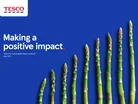
Tesco’s 2025 sustainability report, titled ‘Making a positive impact’, shows how the supermarket giant is tackling food waste, emissions and energy efficiency.
Making a sustainable supermarket
Tesco has placed sustainability at the heart of its corporate strategy, focusing on both operational efficiency and systemic transformation within the retail sector.

Guided by its purpose to serve "customers, communities and planet a little better every day", the supermarket is tackling environmental and social challenges across its supply chain, store operations and customer engagement efforts.
Its "planet plan" outlines six priority pillars:
- Improve products
- Decarbonise transport
- Reduce store emissions
- Support sustainable consumption
- Eliminate waste
- Protect nature
Tesco’s approach includes substantial internal reductions in carbon emissions, supplier engagement on climate goals and targeted community health initiatives.
The company has also invested in sustainable farming partnerships, advocated for stronger policy frameworks and collaborated with NGOs to align retail practices with wider societal and environmental needs.
Tackling food waste
Tesco has set a target to halve food waste in its own operations by the end of 2025, using 2016/17 as a baseline.
As of the latest reporting year, 82% of unsold food suitable for human consumption in the UK was successfully redistributed to people or used as animal feed.
Tesco has invested in infrastructure and partnerships to maximise this redistribution.
Through its network of more than 1,000 community partners and support from FareShare and OLIO, more than 25,000 tonnes of surplus food were redistributed in 2023/24 – equivalent to more than 60 million meals.
Tesco, along with Sainsbury’s, Morrisons and Waitrose, are four supermarkets partnering with FareShare to fight hunger in the UK.
“We are excited to support the ‘Let’s make a meal of it’ campaign and strengthen our partnership with FareShare,” says Matthew Barnes, UK CEO of Tesco.
“Collaboration is key to addressing food insecurity, and we are happy to partner on this with the other retailers.”
The company has also rolled out a new temporary surplus food processing facility which can turn up to 1,000 tonnes of unsold fruit, vegetables and bakery items into animal feed each week, reducing reliance on landfill or incineration.
Internally, the business is continuing to improve forecasting and stock management using machine learning tools, ensuring perishable goods are sold on time.
Tesco has also removed ‘Best Before’ dates from more than 100 product lines to reduce confusion and unnecessary disposal by customers.
In-store initiatives like ‘Reduced to Clear’ sections and donation points are helping to ensure surplus food is used efficiently.
This work is underpinned by Tesco’s advocacy for transparent reporting.
This supermarket was the first UK retailer to publicly disclose its food waste data and continues to call for mandatory food waste reporting across the industry to accelerate national progress.

The company’s partnership with WWF also focused on identifying system-level solutions to reduce waste from farm to fork.
Decarbonisation and renewable energy
Tesco has already exceeded its 2025 target for reducing Scope 1 and 2 emissions, achieving a 65% cut from its baseline ahead of schedule.
The company is aiming for carbon neutrality across its operations by 2035 and net zero across its entire value chain by 2050.
These ambitions are supported by Science Based Targets Initiative (SBTi) validated goals, including an 85% reduction in Scope 1 and 2 emissions by 2030 and a 55% cut in Scope 3 emissions by 2032.
To aid the company’s reduction in emissions, Tesco now sources 100% of its electricity from renewables across group operations.
It has signed the UK’s largest corporate solar Power Purchase Agreement (PPA), securing 65% of output from the 373MW Cleve Hill Solar Park.
Once live, Cleve Hill Solar Park will power the equivalent of 144 large Tesco stores annually.
"We’re delighted to be announcing such a significant step in our journey towards carbon neutrality across our own operations by 2035,” explained Ken Murphy, Group Chief Executive Officer at Tesco.
“Cleve Hill solar park, with its ability to generate up to 10% of our UK electricity demand, joins a number of other Power Purchase Agreements we’ve announced over the last five years.
“With its ability to provide vital energy storage infrastructure, it's a key part of the renewable energy strategy in the UK, and further evidence of our commitment to tackle climate change and source green electricity from innovative projects like this."
A circular economy and supply chain transformation
Tesco continues to advance a closed-loop model for packaging and food waste, aligning with its ambition to halve operational food waste by December 2025.
Some of these changes include switching to paper-based alternatives for pasta and onions and introducing laser-etched labels to eliminate single-use plastics.
Currently, 99% of Tesco’s Own Brand packaging in the UK is recyclable when including wider collection points.
In agriculture, Tesco’s Future Dairy Partnership is working with Arla and Müller to scale innovation in sustainable farming.
This builds on Tesco’s long-standing collaboration with its Sustainable Dairy Group.
"We’ve been playing a leading role in transitioning to a low carbon agriculture sector for some time, through the close long-term partnerships we have with our Tesco Sustainable Dairy Group farmers,” comments Ashwin Prasad, Chief Commercial Officer at Tesco.
“The group has pioneered groundbreaking work on a number of areas, including animal welfare improvements, carbon footprinting and introducing innovations such as methane reducing additives.
“What’s clear is that to achieve our stretching climate and nature goals, we must work together as an industry to implement transformational improvements at pace, so we’re delighted to be partnering with Arla and Müller on this project.
“It’s critical we continue to ensure farmers play a pivotal role in this work, and we look forward to working with them as the work of the partnership is established."
Tesco also prioritises sustainable sourcing across risk commodities like soy, palm oil and seafood.
It aims to use 100% deforestation-free soy from verified sourcing areas by the end of 2025.
Through collaborations like the Responsible Commodities Facility and the UK Soy Manifesto, the company supports farmers adopting deforestation-free practices.
Explore the latest edition of Sustainability Magazine and be part of the conversation at our global conference series, Sustainability LIVE.
Discover all our upcoming events and secure your tickets today.
Sustainability Magazine is a BizClik brand