ABB: How Electrification Can Pave the Way to Energy Freedom
On a winter's evening many years ago in southern Poland, a young engineering student returned home after a long day to find his house cold and dark.
In those days, most of the buildings in Kraków were heated by coal boilers, into which people had to shovel coal each day.
But on this particular evening, Mateusz Zając’s mother had fallen asleep before she could tend the boiler, which meant there was no warm water and the house was a brisk 16°C.
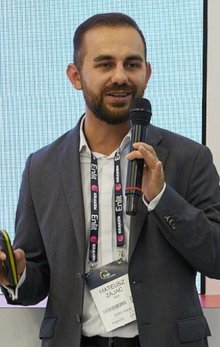
Thinking back now, Mateusz sees the icy shower he took that night as a turning point in his life. “That was the moment I decided that everybody should have access to resilient, modern, affordable and clean energy,” he says. “That’s the philosophy I bring to work every single day.”
This passion has led him to shape energy strategy across 50 countries, as Sustainability Leader of ABB’s Electrification Service.
Mateusz grew up in what he describes simply as “energy poverty”. While most homes in Poland are now comfortably heated (Mateusz himself is a proud heat pump owner), this is a reality that remains a massive issue elsewhere in the world.
So far, Mateusz’s career has taken him from Rolls-Royce’s Marine Division, where he worked on propulsion systems, through a procurement role at Shell, before landing at ABB. He has now spent 11 years at the Swiss industrial giant, where he works on electrification, automation and energy management.
Regardless of the positions he has held, Mateusz has always been guided by steadfast principles.
“For me, sustainability has never been about tightening the belt,” he says. “It's about freedom – freedom for our engineers, our equipment and our energy.”
Of course, companies like ABB, whose machinery and electronics are used in climate technologies the world over, are essential to facilitating that freedom.
“You cannot do the energy transition without the equipment to power it,” Mateusz explains.
What is ABB’s Electrification Service?
Today, ABB Electrification is a US$16bn business that employs 55,000 people worldwide – roughly half of the entire ABB Group. Within it, the Electrification Service Division (ELSE), though a relatively new organisational structure, draws on a century of accumulated engineering expertise.
With US$1.4bn in annual revenues, 4,000 engineers deployed across more than 15 countries and responsibility for over 18 million installations globally, ELSE is, as Mateusz puts it, “a silent enabler of the energy transition”.
Wherever you find mission-critical power infrastructure – utilities, data centres, heavy industry, power plants – you are likely to find ABB equipment close by.
Whether it’s at the top of the Burj Khalifa or at the bottom of the ocean in subsea interconnector systems, ABB is there.
What’s more, the challenge ELSE was made to address has never been more acute. Global electrical demand is growing at around 4% year on year, accelerated sharply by the data centre boom driven by AI.
At the same time, the electrical infrastructure of most modern economies was designed and built 40 or 50 years ago, at a time when today's demand loads were unimaginable.
“Think of the electrical grid as a three-lane motorway,” Mateusz says. “A lot of it was built decades ago, and it's aged well because it's been well-maintained. But in many countries, demand has tripled since it was designed.
“Imagine suddenly having three times as many cars on the motorway. And then imagine some of those cars starting to drive the wrong way – that's what distributed energy resources feeding back into the grid feels like.”
In a sense, ABB is now in the process of laying the road ahead.
The retrofitting philosophy
The question being asked of ABB by utilities, governments and industry alike is the same one being asked across the energy sector: how do you double capacity without tearing everything out and starting again?
The answer, Mateusz argues, is modernisation and retrofitting.
Take a typical ABB ZS1 switchgear unit, for instance. This is a piece of electrical equipment that controls, protects, and distributes power and weighs 1,000kg. Of that total, around 800kg consists of structural components like copper bus bars and steel frames – passive parts that simply do not wear out.
The remaining 150kg are the active components – this is the protection, control and power equipment that does the real work.
“By retrofitting just those 150kg, we keep all the rest intact,” Mateusz says. “You save the embedded carbon in those 650kg of steel and copper, you avoid the civil works and recabling, and you extend the life of the asset by up to 30 years.
“It takes hours rather than weeks, costs roughly 80% less than a full replacement, and saves around 80% of the associated carbon emissions.”
The scale of that installed base lends those numbers real weight. Mateusz says that within ELSE's 18 million installations, there is as much copper as the annual output of two copper mines. “You cannot simply replace all of that,” he explains. “Nor would you want to.”
Energy freedom
Retrofitting and waste reduction form an important part of what Mateusz calls “energy freedom”.
Energy freedom, as Mateusz sees it, sits at the heart of ABB Navigate, a new business line the company has created to help its customers chart their own course to net zero.
Its first product is Battery Energy Storage as a Service and it addresses what, to Mateusz, are the three pillars of the energy challenge – power, price and planet – insofar as batteries can markedly reduce reliance on fossil fuels.
Lately, Europe’s dependence on imported fossil fuels has made price volatility and energy security a front-page issue. “How do we give Europe freedom from that volatility?” he asks.
“Electricity is three to four times more energy-efficient than fossil fuels for converting energy into useful work. And with the right storage and smart pricing, it can be dramatically cheaper and cleaner,” he adds.
With each passing day, battery storage becomes a more central part of the fabric of modern life. In one recent case in England, one of ABB’s customers that was looking to install a large number of EV chargers faced an extensive wait for a sufficiently large grid connection.
By deploying a battery energy storage system instead, ABB enabled the customer to avoid that bottleneck entirely. In fact, the battery managed capacity requirements that the grid simply could not meet.
Better still, the battery's flexibility allowed the customer to participate in grid balancing markets, generating revenue from the outset. The result was no upfront spend, a predictable operational cost and positive cashflow from day one.
“We're no longer asking customers to spend money to be sustainable,” Mateusz explains. “We're showing them how sustainability pays.”
ABB’s approach to circularity
Mateusz and the team at ELSE are also pressing forward with a host of initiatives promoting circularity internally and externally.
The business now offers end-of-life services for its products in 22 countries, and the division is seeing strong interest from data centres in particular.
By taking back retired equipment and ensuring its materials remain in productive use, ABB is building a model of resource sovereignty that mirrors – at an industrial scale – the energy sovereignty it is helping customers achieve.
What’s more, the company is leading by example with its own operations. Its Mission to Zero programme is all about decarbonising factory operations, while its Zero Waste to Landfill initiative is helping to eliminate waste from its manufacturing plants.
Not only does this approach reduce ABB’s carbon footprint – Mateusz is also keen to point out that it fulfils a hugely underappreciated function in terms of reputation and recruitment.
After all, the energy sector is currently facing a chronic shortage of qualified engineers. Mateusz believes that ABB’s sustainable credentials play an important role in attracting the next generation of best-in-class talent.
“The new generation of engineers wants to work for a purposeful company,” he says. “They want to be part of real change. We get to be the good guys in this story.”
Company portals
Executives
Mateusz Zając
Sustainability Leader, Service Division, Electrification