
Carbon Reduction, Scope Emissions & Reaching Net Zero Goals
Carbon dioxide (CO₂) is an essential part of our climate, forming one of the main greenhouse gases (GHGs).
According to NASA, GHGs trap the heat emitted from sunlight and help warm the planet – without this process the world would be too cold to inhabit.
However, due to the increase in GHGs from pollutants, the amount of carbon in the atmosphere is causing global warming and climate change.
Before irreversible actions take place, carbon dioxide needs to be reduced and mitigated.

The different types of emissions
The National Grid states that in order to act against emissions, we need to understand and measure where they’re sourced from.
This is why there are different types of emissions: Scope 1, 2 and 3.
According to National Grid:
- Scope 1 emissions are emissions from sources that organisations own or control directly.
- Scope 2 emissions are those that a company causes indirectly, coming from energy that is purchased and used in production.
- Scope 3 encompasses emissions that are not produced directly from the company itself but from indirect emissions from up and down the value/supply chain.
What is carbon reduction and mitigation
Carbon reduction involves using sustainable and energy efficient methods to reduce the amount of CO₂ emissions produced directly and indirectly.
The United Nations (UN) lists examples of reduction that could be adopted:
- Replace polluting coal, gas and oil-fired power with energy from renewable sources
- Use less energy by reducing heating and cooling use and use energy efficient appliances
- Use renewable energy utility companies
- Walk, bike or take public transport
- Switch to EVs
- Take trains instead of planes – where you can
- Reduce, reuse, repair and recycle
- Eat less meat and dairy produces – where you can
- Reduce food waste
- Clean up the environment.
Where reduction is not possible, mitigation should be the next option.
“Mitigating climate change means reducing the flow of heat-trapping greenhouse gases into the atmosphere,” says The European Environment Agency, a UN department.
Actions like protecting forests, oceans and soil helps to enhance carbon storage and absorption.
Reaching net zero
“Put simply, net zero means cutting carbon emissions to a small amount of residual emissions that can be absorbed and durably stored by nature and other carbon dioxide removal measures, leaving zero in the atmosphere,” says the UN.
The UN states the Earth is already roughly 1.2°C warmer than it was in the late 1800s and emissions continue to rise.
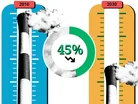
To keep global warming to no more than 1.5°C, as called for in the Paris Agreement, emissions must be reduced by 45% by 2030 to help reach net zero by 2050.
The International Energy Agency says that “the path to net zero emissions is narrow: staying on it requires immediate and massive deployment of all available clean and efficient energy technologies.”
Also stating that a major worldwide push to increase energy efficiency is an essential part of these efforts.
IKEA is aiming to cut absolute GHG emissions across its entire value chain by half by FY30 and by at least 90% by FY50 from its FY16 baseline, without using carbon offsets.
“It's still going to be challenging and a lot of hard work, but there is at least a realism in the goal of 50%," says Par Stenmark, Chief Sustainability Officer at Inter IKEA.
Remaining emissions are trying to be neutralised by removing and storing carbon through forestry, agriculture and IKEA products, using nature based solutions that also support people and nature.
Beyond its own operations, IKEA aims to drive wider emission reductions by advocating for 1.5°C-aligned climate policy, helping customers make more sustainable choices, focusing on low-carbon materials and food, circularity, electrification, renewable energy, efficiency and a holistic approach to climate, nature, air quality, inequality and human rights.
KPMG is also actively working towards its net zero goal by 2050, with validated near-term science-based targets (SBTs) to cut emissions by 50% by 2030.
The firm is aiming to focus on renewable energy (achieved 100% renewable electricity by 2023), reducing gas, transitioning to EVs and engaging suppliers.
Ernst & Young (EY) is making significant progress towards its net zero goals, targeting to halve emissions by FY30 and achieve net zero by FY50, all against an FY19 baseline, focusing on renewables, reduced travel and supplier engagement.
Company portals






Executives

Pär Stenmark
Chief Sustainability Officer for Inter IKEA Group