COP30: Sustainable Cooling Systems Vital to Climate Action

The United Nations Environment Programme (UNEP) released a landmark report in conjunction with the launch of the ‘Beat the Heat’ initiative at COP30.
The report explores the inexorable link between sustainable cooling systems and global climate action. The UNEP suggests that without a revolution in the space heating and cooling sectors, climate change will be impossible to halt.
Regulating the temperature of buildings – whether through air conditioning or heating – is one of the biggest drains on global energy reserves.
According to the IEA, space heating contributes to 40% of all energy-related CO₂ emissions. This report from the UNEP finds that cooling systems account for 20% of all global electricity consumption.
With more extreme temperatures expected more regularly the world over – whether hot or cold – the regulation of indoor climates is going to become a far more energy intensive process.
That, of course, is to say nothing of the skyrocketing cooling demand of data centres, which are springing up all the time as the era of AI kicks into top gear.
The demand for cooling heats up
The Global Cooling Watch 2025 details the pace of global change.
“Installed cooling capacity is on a trajectory to triple by 2050, potentially driving emissions to 7.2 billion tons of carbon dioxide equivalent even with efficiency gains and refrigerant phase-down efforts,” reads the foreword by Winston Chow, Lee Kong Chian Professor of Urban Climate, and Martin Krause, Director for Climate Change at UNEP.
A lot of this growth is in the residential sector. “Space cooling needs in residential and commercial sectors, and cold chain expansion, already use around 20% of global electricity,” the report reads.
“This would push cooling emissions to 7.2 billion tonnes of CO₂e under a Business-as-Usual Cooling Pathway, despite ongoing energy efficiency and refrigerant phase-down policies”.
But while cooling systems are set to contribute to a gigantic proportion of global emissions, they will become utterly necessary for human survival going forward.
Shockingly, despite the huge rise in demand for air conditioning units that is projected for the near future, the UNEP’s report suggests that almost half the world’s population will still be unable to access the systems by 2050.
Home comfort and passive cooling
The central message is that conventional air conditioning, unless drastically reimagined, is both a cause and a casualty of the climate crisis.
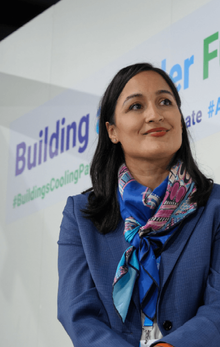
“Current trends demonstrate that societies cannot simply air condition their way out of escalating heat risks,” says Lily Riahi, UNEP Cool Coalition Project Lead.
“Instead, adaptation and mitigation must be addressed together, with systemic approaches [...] integrating passive and active cooling solutions at the national and subnational levels.”
Passive design – using building orientation, external shading, cool roofs, insulation and natural ventilation – can deliver faster and more lasting comfort than energy-hungry air conditioners.
The report’s modelling finds that these measures “can achieve average temperature reductions of 2.2 degrees Celsius and energy savings of 29%”, making them the “most equitable and cost-effective options” for the vulnerable.
Hybrid solutions – like fans combined with AC – are also pointed to as options. “Energy-saving hybrid approaches can cut energy use by more than 30% compared to conventional air conditioning, providing affordable and sustainable comfort solutions,” the report says.
Cooling data centres and digital infrastructure
While most attention focuses on homes, the report singles out the “rising demand from digital infrastructure – most notably data centres, which require continuous, high-efficiency thermal regulation”.
Traditionally reliant on air-based cooling, the sector is shifting towards liquid and hybrid systems that can “cut cooling energy use by 20 to 50%”, supporting far higher rack densities and enabling waste heat recovery.
A case study from the UK shows that “optimising operations [...] could cut data centre cooling demand by 16%, while widespread liquid cooling adoption could lower it by 42% versus business-as-usual”.
“Transitioning to ultra-low [carbon] alternatives and expanding liquid cooling could slash [direct refrigerant] emissions by 93%,” the report suggests.
With the demand for computing, electronics and AI set to skyrocket for the foreseeable future, cooling for digital infrastructure is going to be a necessity.

Policy, equity and the way ahead
Though states and companies are beginning to address the problem of cooling with policy, the UNEP report is crystal clear about the scale of the challenge to come.
“Only 54 countries have policies across all three measures consistent with the Sustainable Cooling Pathway,” its authors reveal.
“Critical implementation gaps remain in building energy codes worldwide, particularly in developing regions where regulatory frameworks lag urgent cooling needs.”
The Global Cooling Pledge, launched at COP28 and expanded at COP30, now unites 72 countries and 80 non-state actors aiming to cut cooling-related emissions by 68% globally by 2050, saving up to US$43tn in cumulative energy and grid infrastructure costs, according to UNEP.
Though the situation is endlessly complex, for experts like Lily, the route forward is obvious: “By making sustainable cooling the foundation of heat resilience, we can protect lives and livelihoods today while preserving the places, traditions and futures we hold dear.”
Company portals

Executives
Lily Riahi
Head of the UNEP Cool Coalition Secretariat