COP30 Protests: Why Indigenous Brazilians Are So Angry
COP30 had been under way for three days when its first controversial moment occurred.
Disputes are never far away at the UN's global climate conferences, but the scenes of protesters storming the conference in Belém illustrate how volatile the mood is this year.
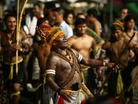
On the evening of 11 November, dozens of demonstrators, many wearing traditional indigenous dress and brightly coloured feather headdresses, forced their way past security and into the venue's Blue Zone, pushing at least one door off its hinges in the process.
UN security personnel scrambled to contain the breach, leading to physical confrontations that left two guards with minor injuries, according to a UN spokesperson.
Protesters carried banners reading "our forests are not for sale" and wore shirts bearing the logo of Juntos, a left-wing Brazilian youth movement.
"They cannot decide for us without us," some chanted, according to Agustin Ocaña, Founder of the Global Youth Coalition, speaking to the frustrations over indigenous peoples' role in the conference proceedings.
The breach represents a highly unusual security incident at a UN climate summit, where strict protocols typically prevent such intrusions.
Authorities from the UN and the Brazilian government have launched an investigation into how protesters managed to penetrate the venue's security perimeter.
However, at least one observer welcomed the disruption. "At last, something has happened here," said Juan Carlos Monterrey-Gómez, Vice President of the Bureau for Latin America & the Caribbean at UN Climate Change.
Why Brazil's indigenous peoples are angry
The incident underscores deep tensions surrounding this year's summit, which has been dubbed "the Indigenous peoples COP" by organisers who promised to place indigenous communities at the centre of negotiations.
Nevertheless, much of Brazil's indigenous peoples are unhappy with their government's impact on the local environment.
"We can't eat money," an indigenous leader from the Tupinamba community told Reuters last night, expressing anger over continued development in the Amazon rainforest which sits a stone's throw from Belém.
"We want our lands free from agribusiness, oil exploration, illegal miners and illegal loggers," he added.
The protesters' frustrations reflect broader contradictions in Brazil's approach to climate action.
While President Lula has sought to position his government as a champion of environmental protection, protestors are furious that Brazil continuing to grant new licences for oil and gas exploration.
At the summit's opening ceremony, Lula told the congregation that COP30 would be "the COP of truth" and called for the world to "defeat" climate denialism.
Is Belém a controversial choice to host COP?
The choice of Belém as a host city has proved controversial, despite organisers' intentions to use it to highlight the Amazon's role in climate solutions.
Speaking with the media following the protests, Agustin suggested that indigenous communities have felt overlooked as resources poured into building "a whole new city" for the conference, rather than funding education, health and forest protection.
"They were not doing this because they were bad people. They're desperate, trying to protect their land, the [Amazon] river," he said in reference to the protestors.
According to the UN, indigenous peoples safeguard around 80% of the planet's remaining biodiversity, yet they receive less than 1% of international climate funding.
Brazil's Minister of Indigenous Peoples Sonia Guajajara has described COP30 as a "historic" event, estimating that 3,000 indigenous people from around the world would attend.
The participation of civil society at COP30
For COP30, Brazilian authorities have actively encouraged civil society participation and street demonstrations, with a "people's summit" scheduled for Thursday and Friday and a major demonstration planned for Saturday.
Indigenous leaders from Brazil, including Raoni Metuktire and Davi Kopenawa Yanomami, are expected to arrive on Wednesday leading a flotilla of about 100 vessels into Belém.
The summit takes place ten years after the Paris Agreement, in which countries pledged to restrict global temperature rises to 1.5°C above pre-industrial levels.
Delegates from nearly 200 countries are attending the talks, which officially run from 10 November to 21 November.

The summit continues amid tensions
Following Tuesday's breach, a UN spokesperson confirmed that "the venue is fully secured and COP negotiations continue," though the incident has cast a shadow over proceedings.
The confrontation highlights the challenging balance between inclusive participation and security at international climate negotiations, particularly when those most affected by environmental destruction feel excluded from decision making processes.
Whether Tuesday's incident represents an isolated outburst or signals broader unrest remains to be seen, but it has already succeeded in drawing global attention to indigenous peoples' demands for meaningful participation in discussions about their homelands.