How BYD is Harnessing AI to Accelerate Global EV Production
The UK has now emerged as BYD’s largest overseas market after sales in September hit 11,271 units – nearly 10 times the 1,150 sold in the same month last year.
This surge has boosted BYD’s share of the UK EV sector to 3.6%, making it the nation’s second-biggest electric car seller behind Tesla. This success comes despite BYD not benefiting from the government’s £650m subsidy package unveiled in July.
The programme offers savings of up to US$5,000 per car, but Chinese-manufactured vehicles are excluded following concerns about emissions from the company's production processes.
"We want to see steady growth and we want people to see we are a technology company," says Bono Ge, BYD’s Country Manager for the UK & Ireland.
Bono also confirmed plans to roll out BYD’s ultra-fast charging network across the UK and Europe next year, further anchoring its position in the region.
Scaling up with the help of AI
BYD's rapid ascent from producing 500,000 vehicles in 2017 to more than four million by 2024 has been underpinned by the extensive deployment of AI across its manufacturing operations.
Often, efficiency has been the name of the game. The company has reported a 40% reduction in battery defects and a 20% improvement in average battery lifespan thanks to several AI-powered quality control measures it has recently introduced.
In the factories, advanced neural networks are continuously analysing real-time sensor data from production lines, monitoring for microscopic deviations in material composition and electrode alignment that manual inspection often doesn’t uncover.
Scaling with AI
BYD’s growth trajectory – rising from 500,000 units in 2017 to over four million by 2024 – is tied closely to its broad use of AI across manufacturing.
Efficiency has been central to this push. AI-based quality control has cut battery defects by 40% while extending average battery lifespan by 20%.
Inside its plants, advanced neural networks process real-time sensor data, detecting minute irregularities in electrode placement and material composition that human inspection often overlooks.
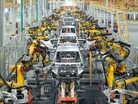
Take BYD’s Xi’an plant as an example – it operates with approximately 97% automation, deploying AI-guided robotics, automated transport systems and smart storage facilities.
The business has also constructed digital twins of its production environments, enabling engineers to trial virtual manufacturing runs and fine-tune processes without extensive physical prototyping.
"The battery is up to 40% of an EV's cost,” says Wang Chuanfu. “Our in-house control over this is our competitive edge."
A holistic strategy
Around 75% of BYD vehicle components are made internally – including its trademark Blade Batteries, motors and electronic systems.
In contrast, UBS analysis estimates that Tesla’s China-made Model 3 incorporates 46% in-house components.
BYD Semiconductor, a subsidiary of the firm, is now building custom AI chips capable of 80 trillion operations per second.
These are intended to rival performance from established players such as Nvidia and Horizon, moving BYD closer to fully domestic production capabilities.
BYD is also working with Taiwan’s TSMC and MediaTek to produce a 4-nanometre smart cockpit chip.
Internal assessments suggest that a BYD model comparable to Tesla’s Model 3 can be made at 15% lower cost than at Tesla's Shanghai Gigafactory.

Driven by data
Earlier this year, BYD unveiled its ‘Intelligent Driving for All’ scheme, making advanced driver assistance features standard across all models with no extra fee.
The system, dubbed ‘God’s Eye’, operates across all price segments from US$9,555 entry vehicles to premium lines.
"If the data from one car is a drop of water, BYD possesses an ocean," Wang said at one of BYD's recent launch events.
This contrasts with Tesla’s Full Self-Driving package, which requires an US$8,000 one-off payment or a subscription, restricting its uptake to certain customers.
A bumpy road ahead?
Despite the momentum, BYD faces heightened regulatory oversight in Western regions due to worries over data safety linked to Chinese AI integration.
The European Union has introduced a 17.4% levy on BYD cars, on top of the pre-existing 10% tariffs on Chinese imports.
Meanwhile, British carmakers face all manner of challenges: Nissan downsizing operations, JLR contending with cybersecurity issues and BMW putting its US$780m Oxford Mini plant investment on hold.
"Europe has opened the door to cheap and impressive Chinese vehicles that, if we're not careful, are going to take over," warns Lynn Calder, CEO of Ineos Automotive.
Company portals





Executives
Bono Ge
Country Manager for the UK & Ireland

Wang Chuanfu
CEO