
How Sustainable is China's Wind-Powered, Subsea Data Centre?
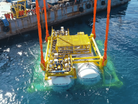
China has switched on the world’s first commercial underwater data centre, marking a milestone in sustainable digital infrastructure.
Located in Lingshui County, Hainan Province, the project represents a major step in China’s ambition to expand its blue economy and attract foreign investment through its pilot free-trade zones.
The servers, which handle digital services from travel recommendations to restaurant suggestions, are installed inside a 1,300-tonne underwater data cabin.
Sitting 35 metres beneath the sea surface, each cabin contains 24 server racks capable of hosting between 400 and 500 servers.
Renewable energy powers deep-sea design
Project manager Pu Ding, from Shenzhen HiCloud Data Centre Technology, says submerging the data cabin delivers major efficiency gains.
“We put the entire data cabin in the deep sea because seawater can help cool down the temperature.
“Compared to land-based data centres, data centres under the sea can reduce energy consumption needed for cooling, helping to lower operational costs,” he said in an interview with Financial News.
Hainan’s 14th Five-Year Plan includes up to 100 underwater data cabins as part of an integrated industrial estate dedicated to new technologies for the marine economy.
A second underwater data centre has been completed in the Lin-gang Special Area of Shanghai’s Pilot Free Trade Zone.
Flagged as the world’s first wind-powered underwater data centre, the US$226m project draws 95% of its electricity from offshore wind farms, using the cool seabed environment to dissipate heat naturally.
Lin-gang’s subsea system is designed to reduce total power consumption by 22.8%, eliminate fresh water use and cut land occupation by more than 90%.
The first phase of construction has achieved a Power Usage Effectiveness (PUE) rating of no higher than 1.15, well below China’s national target of 1.25 for large-scale facilities by 2025.
Data centres are notorious for their energy intensity, particularly for cooling.
Large facilities can consume up to five million gallons of water per day.
Strategic response to global data demand
The rapid expansion of cloud computing and generative AI is fuelling global demand for high-performance data infrastructure.
China’s pilot programme allows foreign ownership of data centres and value-added telecoms services in Hainan, Shanghai, Beijing and Shenzhen.
The strategic move enables China to attract multinational tech giants.
The Lin-gang project is also designed to power AI workloads, 5G infrastructure, industrial Internet of Things (IoT) applications and e-commerce systems.
Lessons from international prototypes
China is hoping to learn from previous experiments with underwater data centre technology.
In 2014, Microsoft began developing Project Natick, an underwater data centre initiative that saw a 855-server prototype submerged off the coast of Scotland in 2018.
After two years of testing, the company concluded the project in 2024, choosing not to pursue commercial deployment.
China is scaling its model from demonstration to full-scale operation. The Lin-gang project currently has a 2.3-megawatt capacity, but phase two is expected to reach 24 megawatts, with future projects targeting up to 500 megawatts of offshore wind-powered capacity.

Environmental performance and design efficiency
Powered almost entirely by offshore wind turbines, the facility harnesses one of China’s richest renewable energy resources.
Huang Dinan, president of Shenergy Group, another key contractor, noted that the East China Sea offers over 3,000 hours of annual wind utilisation – making it an ideal location for hybrid wind–digital infrastructure.
By eliminating the need for land-based cooling towers, air conditioning, and freshwater use, the project reduces its ecological footprint.
Land use has fallen by over 90%, freeing valuable coastal space in high-density urban areas.
Meanwhile, the project’s integration with the seabed raises new research opportunities in marine engineering, corrosion resistance and biodiversity impact assessment.
A cornerstone of China’s digital future
Shanghai’s ambition to become a global hub for scientific and technological innovation is underpinned by the growth of its cloud computing industry, projected to exceed US$28bn by 2027.
The Lin-gang UDC supports this vision, aligning with national strategies to strengthen China’s digital infrastructure while meeting its carbon-reduction commitments.
The initiative also complements China’s East Data, West Computing megaproject, launched in 2022.
That programme aims to build data centres in western provinces to process information generated by the more developed eastern regions.
Future challenges for sustainable data infrastructure
Phase two of Lin-gang’s underwater data centre will expand its capacity tenfold, while new offshore wind-powered facilities are already planned.
In the long term, such developments could support China’s ambitions to lead in green computing, AI infrastructure and smart city integration.
However, the technology’s future depends on solving key challenges:
- Maintenance and reliability – ensuring that subsea servers can be repaired and upgraded efficiently
- Marine ecosystem management – studying and mitigating any impact on local biodiversity
- Cost and scalability – driving efficiencies to make UDCs commercially competitive with conventional data centres.