
The World's First Land-Based Marine Hydrogen Engine
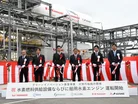
Kawasaki Heavy Industries, Yanmar Power Solutions and Japan Engine Corporation have completed the world’s first land-based operation of marine hydrogen engines, a step that brings zero-emission deep-sea shipping closer to reality.
The demonstration ran at Japan Engine’s headquarters factory using a newly installed liquefied hydrogen fuel supply system designed for both high and low pressure delivery.

Why does this matter?
International shipping must decarbonise at pace.
The project is part of Green Innovation Fund Projects / “Next Generation Ship Development” of the New Energy and Industrial Technology Development Organisation (NEDO).
By providing stable hydrogen combustion on shore, the partners have de-risked crucial technology for main propulsion and auxiliary power across multiple engine classes.
Each engine is dual-fuel, switching between hydrogen and diesel when required, which preserves redundancy while enabling a significant cut in GHG emissions during hydrogen operation.
“Liquid hydrogen is a vital key to realising a sustainable energy society, and we have long been committed to building the technological foundation to support it,” says Kei Nomura, Executive Central Manager, Hydrogen Strategy Division, Kawasaki Heavy Industries, Ltd.
“Kawasaki Heavy Industries possesses proven technologies and experience in the production, storage, transportation, and reception of liquid hydrogen.
“Going forward, we remain committed to expanding the use of liquid hydrogen through global partnerships and accelerating the transition to a decarbonised society.”
Inside the demonstration
Under NEDO’s "Development of Marine Hydrogen Engine and MHFS" programme, Kawasaki Heavy Industries built a new liquefied hydrogen fuel supply system that stores and vaporises liquid hydrogen, delivering it at high and low pressure to engines from all three partners.
This enables testing across low-speed two-stroke main propulsion engines, four-stroke auxiliary engines and four-stroke main generator engines for electric-propulsion ships.
Kawasaki Heavy Industries and Yanmar Power Solutions have demonstrated hydrogen combustion in medium-speed four-stroke engines, confirming stable operation at rated output as they work towards zero emissions.
Development will continue to refine performance.
Japan Engine is advancing a low-speed two-stroke hydrogen engine, with first operation planned for spring 2026.
All three engines share a dual-fuel capability, switching between hydrogen and diesel as needed to cut GHG emissions while maintaining redundancy.
Following the land-based demonstrations, the partners will work with shipowners and shipyards to run onboard trials, moving towards real-world deployment.
By bringing together Japanese manufacturing strengths, Kawasaki Heavy Industries, Yanmar Power Solutions and Japan Engine aim to lead global adoption of hydrogen-fuelled ships and help deliver carbon neutrality by 2050.


Executives

Kei Nomura
Executive Central Manager, Hydrogen Strategy Division