TotalEnergies, BASF & Siemens: What is Hydrogen Power?
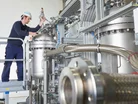
When burnt, hydrogen produces water instead of CO₂, giving it potential to be a more sustainable fuel.
Hydrogen can be directly combusted in engines, like fossil fuels, or used to generate electricity within fuel cells.
Governments and trade blocs, like the EU, are already creating hydrogen strategies to boost production.
Hydrogen is classified by colour codes, with green using clean energy and grey using fossil fuels.
What are the types of hydrogen?
Grey hydrogen is produced using the steam reformation process, in which hydrogen gas is extracted from natural gas.
This process releases significant amounts of CO₂ as a byproduct.
Another common method of producing grey hydrogen is autothermal reforming using oxygen and carbon monoxide.
Autothermal reforming also creates carbon emissions.
Blue hydrogen is created using the same processes but involves capturing CO₂ emissions using carbon capture and storage (CCS) technologies.
Green hydrogen is made using clean energy sources through processes like electrolysis.
Electricity produced from renewable energy sources, like wind or solar, is used to electrolyse water to separate it into its component elements, hydrogen and oxygen.
Demand for hydrogen has grown more than threefold since 1975 according to the International Energy Agency (IEA) Global Hydrogen Review 2024.
The report says that demand for low-emissions hydrogen grew almost 10% in 2023.
Why is hydrogen fuel needed?
According to the United Nations, 107 countries responsible for around 82% of greenhouse gas emissions have adopted net zero pledges as of June 2024.
Because of its versatile nature, hydrogen could replace fossil fuels in a variety of applications.
In hard-to-abate sectors, like long-haul transportation, chemicals, iron or steel, green hydrogen can serve as a viable alternative.
According to the International Renewable Energy Agency (IRENA), hydrogen could serve 12% of energy demand in 2050 and replace fossil fuels in these applications.
Global demand for green hydrogen is projected to reach 530 million tonnes by 2050, with an estimated export market of US$300bn per year in a 2020 PwC report.
Hydrogen power in action
From race cars to cruise ships, aeroplanes to recycling plants and high speed trains to everyday cars, hydrogen power is slowly but surely making its mark.

With a combined investment of more than €1bn, TotalEnergies and Air Liquide have partnered to invest in two large-scale electrolysers which produce low carbon hydrogen to decarbonise their refineries in Northern Europe.
Emilie Mouren-Renouard, Air Liquide’s Group Vice President for Europe, Africa, Middle-East and India, says: “We are proud to lead the way on European renewable and low-carbon hydrogen production, and to accompany TotalEnergies in their journey to decarbonising their industrial assets.”
In Germany, BASF and Siemens have lined up a green hydrogen project which aims to produce up to a tonne of green hydrogen per hour.
Alex Richards, Vice President & Regional Segment Leader at Schneider Electric, believes that green hydrogen could save the UK's declining steel manufacturing.
He says: "Producing DRI [Direct Reduced Iron] using green hydrogen can result in over a 95% reduction in CO₂ emissions compared to steel produced with coal.
“This presents an opportunity to sustain a steel industry with significantly less environmental impact,”
Challenges for hydrogen power
Liquid hydrogen has a volumetric energy density of 8 MJ/L according to the US Department of Energy.
This is a quarter of that of gasoline, which is 32 MJ/L.
Because of this, a higher volume of hydrogen is needed for the same amount of energy in gasoline.
More sophisticated methods of storage, like cryogenic methods or high-pressure tanks, may be needed to overcome this challenge.
According to the IRENA, only 1% of the current global hydrogen output comes from renewable sources.
Production of green hydrogen requires investments in renewable energy plants, equipment like electrolysers, development of storage methods and the creation of hydrogen distribution and refuelling infrastructure.
This makes hydrogen projects highly capital intensive and huge investments may be needed to make it an accessible fuel for everyday consumers.
Hence, optimising the hydrogen supply chain could be important to economically cementing hydrogen as a fuel of the future.
Company portals




Executives
Alex Richards
Vice President & Regional Segment Leader
Emilie Mouren-Renouard
Group Vice President for Europe, Africa, Middle-East and India