Is There a Better, More Sustainable Daily Commute Than This?
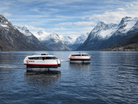
Stories of nightmare commutes are legion, so do not read on if you suffer from travel envy.
For, as if the breath-taking backdrop of the fjords is not enough, Norway’s coastal commuters will soon feel that they are floating on air.
Boreal AS has ordered a fleet of 20 Candela P-12 electric hydrofoil vessels that Candela is calling the “magic carpet” for passengers.
It is the latest pioneering move in Norway, which has the highest proportion of electric cars per person and continues to lead the world in sustainability.
Electric dream to decommission diesel?
The quest to decarbonise maritime transport has often foundered when confronted by the challenge of matching the range and energy intensity of high-speed vessels. While Norway leads the world in electric car sales, with 99% of new car sales EVs, the hurtigbåtar fast ferries that connect its 100,000 miles of fjord-lined coast have traditionally relied on diesel.
Boreal AS is changing the narrative with its order for 20 Candela P-12 electric hydrofoil vessels. These boats do not just float; they fly. By lifting the hull above the water, drag is reduced so significantly that energy consumption drops by 80%.
This makes zero-emission travel possible on routes that previously required fossil fuels.
Nikolai Knudsmoen Utheim, CEO at Boreal, says: “Norway has already led the electrification of maritime transport. With this fleet, Boreal wants to take the next step – accelerating zero-emission high-speed travel along the Norwegian coast.” Nikolai believes this investment will help bring electric vessels to new markets beyond Norway.

Lifting vessels above the waves
The P-12’s environmental credentials extend beyond its lack of tailpipe emissions. Because it hydrofoils, it creates virtually no wake.
In the unique and sensitive Norwegian fjords, traditional high-speed craft can cause erosion and disturb marine ecosystems. The P-12 solves this elegantly. At speeds above 18 knots, computer-controlled wings lift the hull, allowing the boat to glide silently and smoothly. This reduced energy demand allows the vessel to operate with a range of 40 nautical miles at a cruising speed of 25 knots.
Alexander Sifvert, Candela’s European Director, says that tourists and commuters will enjoy service "without the negative impacts of wake and emissions in the unique Norwegian fjords".
Alexander says that forward-thinking operators can now accelerate the shift to sustainable travel while simultaneously reducing operational costs. The 80% reduction in energy consumption is significant for ESG targets and operational budgets.
Quiet travel redefines experience
The vessel is also engineered for "social" sustainability – the comfort of the passengers and the peace of the coastal communities.
Recent tests in Stockholm confirmed cabin noise levels of 64 dB: lower than modern trains or aircraft. “Tourists and commuters in Norway will enjoy better service and more frequent departures – free from seasickness, silent,” adds Alexander. The result is a premium travel experience that respects the silence of the natural environment.
Gustav Hasselskog, Candela’s CEO and Founder, describes the experience as surreal. “If there ever was a magic carpet, we’ve made it,” says Gustav. This "magic carpet" effect is produced by the Flight controller, which adjusts the hydrofoils in real time to ensure the cabin remains level even in rough seas.
For the operator, this means less downtime due to weather and a vastly improved service for those prone to seasickness.
Scaling sustainable maritime networks
The fleet of 20 vessels is planned for yearly batches between 2028 and 2030, with the first two arriving in 2027. This is the world’s largest electric hydrofoil fleet to date.
The P-12 can fully recharge in an hour using standard DC car fast chargers, avoiding the expensive megawatt-scale charging systems required by conventional electric ferries.
The capability was recently demonstrated during a voyage between Sweden and Norway, when the P-12 completed the longest electric sea journey to date, recharging along the route using a mobile battery system transported by a Ford F-150 Lightning pickup.
By choosing a vessel that can charge with standard DC car chargers, Boreal avoids the environmental and financial cost of building megawatt-scale infrastructure.
“Candela P-12 is the only electric passenger vessel that combines longer range with high speed without requiring extensive charging infrastructure. Our investment will enable new high-speed routes both in cities and in rural areas,” says Nikolai.
“Charging infrastructure is the hidden cost of electrifying conventional vessels,” says Gabriele De Mattia, project engineer at Candela and lead engineer for the record-setting voyage.
“In many cases, building megawatt-scale chargers – especially where the grid is weak or undeveloped – can cost as much as the vessels themselves. The breakthrough with P-12 is that it is fast to charge and extremely flexible in where it can operate.”
Company portals

Executives
Gustav Hasselskog
Founder & CEO