LCAW: Integrating Nature into Corporate Tech Strategies
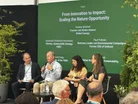
As part of London Climate Action Week, leaders gathered to share strategies for incorporating nature into business strategies.
The panel 'From Innovation to Impact: Scaling the Nature Opportunity' featured leaders from HSBC, GSK, EY and the Taskforce on Nature-related Financial Disclosures (TNFD).
At the discussion, chaired by Alexis Gazzo, Global Climate Change and Sustainability Services Leader at EY, corporate strategies were shown to be rapidly evolving to embed environmental considerations directly into core operations.

"Five years ago, asking a company about their nature strategy usually meant they had planted a forest or put a green roof on a factory," said David Craig, Co-Chair of TNFD.
"The conversation is changing and financing is emerging. Business now has a much better understanding of the interface with nature."
To guide this transition, organisations are adopting the LEAP (Locate, Evaluate, Assess, and Prepare) framework to analyse corporate risks.
David explains: "Hundreds of companies are assessing bottom-up where their dependencies and impacts on ecosystem services create risk and opportunity."
This analytical approach is altering global corporate behaviour, forcing executive teams to rethink long-term procurement, operational models and geographical locations.
"Over 40% of companies making an assessment are publicly declaring they are changing their strategy and procurement as a result," David says.
Assessing corporate dependency on water
The pharmaceutical sector faces distinct vulnerabilities regarding resource scarcity, making nature an immediate commercial priority rather than a distant regulatory concern.
"Without nature and water, we cannot manufacture medicines and vaccines that people rely on," says Adele Cheli, VP Sustainability at GSK. "For us, it is a business imperative."
She notes that climate targets cannot be achieved in isolation and require synchronised investments in natural systems alongside carbon-reduction efforts.
Adele explains: "Nature is fundamental to climate change. If we are serious about climate, there is no net zero without investments in nature."
GSK has piloted water stewardship frameworks in collaboration with the Science Based Targets Network to test local interventions.
Adele continues: "We worked with local partners at the basin level to replenish water through nature-based solutions. That enabled us to scale the approach."
The financial sector is simultaneously modifying its frameworks to channel capital into ecological transition projects and specialised technology platforms.
Susannah Fitzherbert-Brockholes, Director of Sustainability Strategy at HSBC, identifies distinct areas where environmental financing is currently flowing: "The first is the transition of the real economy. That impact reduction is particularly the case where nature comes alongside climate."
Technology infrastructure represents a critical focal point for this capital, particularly regarding the substantial resource footprint of digital operations.
Susannah says: "Data centres can have significant environmental impacts, particularly concerning water stress. Water usage can now be a strategic enabler for projects."
Scaling innovation within nature tech
Sustainable financing now incorporates specific water metrics alongside traditional climate metrics to evaluate infrastructure viability and operational licenses.
Susannah explains: "We are seeing cases where water performance indicators are integrated alongside climate and social indicators for sustainable financing for data centres.
"We are seeing exciting businesses coming through in bioplastics, geospatial monitoring and biodiversity monitoring. We support these early-stage companies to scale.
"A massive global bank can connect them with companies who want to procure services, helping to create a market for them.
"You can do a huge amount with what you have today. It is about rolling out existing products and not re-engineering things."
Ecological factors offer highly visible, immediate feedback loops that make them easier for front-line commercial lenders to comprehend.
Overcoming data barriers in business
David emphasised that natural asset metrics are inherently tangible and directly influence agricultural supply chains and corporate risk profiles.
David says: "The quality of soil, nutrients and water retention has a direct impact on a farmer’s livelihood and the risk profile of commercial lending."
He urged corporate executives to move past data anxieties and elevate ecological risks directly to boardroom strategic debates: "Don't be scared or allow people to say there is not enough data. Get board coverage because it is a board-level issue."
Adele echoed this sentiment, advising companies to abandon the pursuit of flawless metrics and focus immediately on practical implementation.
"Put aside perfection or perfect data and just keep going," she says. "There is enough data and guidance today for any company to do something meaningful."