Seconds Faster, Billions Saved: The New Age of Weather AI
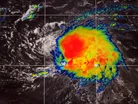
Red sky at night, shepherd's delight. Humans have been trying to predict weather for thousands of years. Beyond planning a picnic, weather forecasting can be used to cut disaster mortality, balance energy grids and support transport routing.
As climate change makes weather more extreme, there are higher stakes to contend with. Accurate, timely weather forecasts can protect people and reduce losses. As the climate continues to change, continuous forecasting and recalibration are needed to keep on top of what could happen next.
Read the full story in Issue 58 of Sustainability Magazine.
The impacts of weather forecasting
Extreme weather, climate and water-related events caused nearly 12,000 disasters from 1970 to 2021 according to the World Meteorological Organization (WMO). Reported economic losses reached US$4.3tn and the death toll is at two million, with 90% of these in developing countries.
The number of reported deaths per decade has fallen, which the WMO attributes to early warnings. However, reported economic losses have grown from US$183.9bn in the 1970s to US$1,476.2bn in the 2010s.
Climate change is increasing risks to electricity security across both generation and networks. The IEA found that without timely integration measures, including improved forecasting, power systems could jeopardise up to 15% of wind and solar generation by 2030.
The European Organisation for the Safety of Air Navigation (Eurocontrol) analysis found that weather like windstorms can cause aviation delays. Maximum wind speeds and rates of precipitation for tropical cyclones is set to increase according to the Met Office, which could impact both passenger travel and freight.
The impacts of extreme weather on ships can threaten life, property and the marine environment. The International Maritime Organization (IMO) found that the routing of shipping to avoid wave and wind resistance can reduce fuel consumption alongside reducing risks created by extreme maritime weather events.
AI’s impact on weather forecasting
AI could help to improve weather forecasts with increased speed, accuracy resolution, scale and even cost savings. Organisations around the world, both public and private, are developing ways to put AI to use in forecasting.
Aardvark Weather is an AI weather prediction system created by researchers from the University of Cambridge with support from the Alan Turing Institute, Microsoft Research and the European Centre for Medium Range Weather Forecasting. This tool learns directly from data, making it simple and flexible. This gives it the potential to be quickly adapted to produce bespoke forecasts for specific industries or locations.
Nowcasting, which forecasts the immediate hours ahead, can help to enhance disaster preparedness. It uses real-time information from observational sources, like weather radars and satellites, to predict sudden, high-impact weather phenomena.
The WMO Integrated Processing and Prediction System (WIPPS), in collaboration with the World Weather Research Programme (WWRP), is implementing the AI for Nowcasting Pilot Project (AINPP). It aims to bring together experts from National Meteorological and Hydrological Services, universities, research institutions and leading private-sector companies like Google, Microsoft and Nvidia. The University says that when using just 10% of the input data of existing systems, Aardvark already outperforms the United States national GFS forecasting system on many variables.
NASA has partnered with San Francisco-based Planette to develop QubitCast, a quantum-inspired AI platform capable of predicting extreme weather events months in advance. The system uses algorithms rooted in quantum physics principles to enable simultaneous evaluation of countless atmospheric scenarios, processing comprehensive data from atmospheric, oceanic and terrestrial sources efficiently.
The top companies using AI for weather forecasting
1. Google: WeatherNext can deliver faster and more efficient forecasts for business critical operations affected by weather.
2. Microsoft: Microsoft developed Aurora, a foundation model reporting state-of-the-art skill and near-instant 10-day forecasts.
3. Nvidia: Earth-2 provides AI models and microservices for ultra-fast, high-resolution weather and climate workflows.
4. IBM: IBM’s Environmental Intelligence Suite ingests forecast and historical data to deliver alerts, dashboards and APIs for operations.
5. Amazon: AWS hosts large-scale forecasting stacks and case studies to support delivery of AI-enhanced forecasts to global users.
6. Huawei: Pangu-Weather demonstrated strong medium-range performance and very fast runtimes against traditional weather prediction.
7. Alibaba Group: DAMO Academy’s “Baguan” model targets 1 km, hour-by-hour predictions up to 10 days.
8. Fujitsu: Fujitsu supplies the Japan Meteorological Agency’s newest supercomputer to improve typhoon and extreme-rain prediction.
9. Atos: Atos’ BullSequana supercomputer is used by leading weather forecasting organisations.
10. HPE: HPE Cray EX systems are used by the Met Office and NOAA-class centres.
WeatherNext: Google’s AI answer to weather forecasting
WeatherNext is a family of AI models from Google DeepMind and Google Research which the company says are “faster and more efficient than traditional physics-based weather models and yield superior forecast reliability”.
"WeatherNext will change how businesses use AI for business critical operations affected by weather, including better planning for retail inventory, logistics disruptions, manufacturing production needs, distribution line maintenance and many other uses," says Carrie Tharp, VP, Global Solutions & Industries at Google Cloud. "By providing our most advanced weather forecasting AI technology, our customers can make more informed decisions, have better-protected infrastructure, and stronger business continuity as weather patterns evolve."
Google has made WeatherNext available to its Cloud enterprise customers to support businesses in energy, retail, financial services and more to prepare for extreme weather events.
"Opening WeatherNext to enterprises expands its applications from the research lab to the real world," says Pete Battaglia, Director of Research for Sustainability at Google DeepMind. "It puts companies in the driver's seat to proactively prepare for extreme weather and better serve their communities."
Microsoft’s Aurora AI foundation model
Aurora is a foundation model developed by Microsoft Research that forecasts a wide range of environmental events. Microsoft says that it comes at a lower computational cost than traditional numerical forecasting and can have greater precision and speed.
Because it is a foundation model, Aurora is not limited to just AI weather forecasting. It has more than a billion parameters and can handle a wide range of prediction tasks, even in data-sparse areas. It can be specialised to go beyond traditional weather forecasting, such as for predicting air pollution, waves or even tropical cyclones.
“We’re not putting in strict rules about how we think variables should interact with each other,” says Megan Stanley, a Senior Researcher at Microsoft Research AI for Science. “We’re just giving a large deep-learning model the option to learn whatever is most useful. This is the power of deep learning in these kinds of simulation problems.”

Although initially training Aurora is costly, a study titled A foundation model for the Earth system published in Nature found that its operational expenses are significantly lower than those of traditional weather systems once it is fully functional.
How Nvidia supports weather forecasting with AI
Nvidia’s Earth-2 is a cloud and GPU platform for building and running AI-accelerated weather and climate digital twins. It bundles development tools, microservices and reference implementations for simulation, AI inference and visualisation. FourCastNet, a global, medium-range AI forecast model is an Earth-2 microservice and can emulate atmospheric dynamics at low cost.
CorrDiff is a generative downscaling model that turns coarse global fields into kilometre-scale guidance. Nvidia says that it is up to 1,000 times faster and 3,000 times more energy efficient than traditional high-resolution runs on a like-for-like task.
StormCast is a generative AI model for emulating high-fidelity atmospheric dynamics. Nvidia says it can enable reliable weather prediction at mesoscale, critical for disaster planning and mitigation.
“The production of computationally tractable storm-scale ensemble weather forecasts represents one of the grand challenges of numerical weather prediction,” Tom Hamill, Head of Innovation at The Weather Company, told Nvidia. “StormCast is a notable model that addresses these challenges, and The Weather Company is excited to collaborate with Nvidia on developing, evaluating and potentially using these deep learning forecast models.”
Company portals










Executives
Carrie Tharp
VP Global Solutions & Industries - Google Cloud

Megan Stanley
Senior Researcher at Microsoft Research AI for Science