
The Sustainability Headlines of the UK's 2025 Autumn Budget
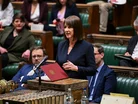
UK Chancellor Rachel Reeves today delivered the Labour government's second Autumn Budget since taking office in 2024, announcing the UK’s plans to raise and spend money for 2026 and beyond.
It was a budget that had been dubbed as being particularly high stakes for Reeves and UK Prime Minister Kier Starmer, with their administration losing support on both sides of the political spectrum, from opposing parties the Greens and Reform.
With the pressure on, the Chancellor walked a line that was most likely to leave those on the left and right unanimated, with both income tax and national insurance rates remaining the same.
“I’ve made my choices: not reckless borrowing, not dangerous cuts, but stability for our economy, security for our public finances and security for family finances too,” she said. “Those are the Labour choices.”
As such, the Budget was lighter on spending announcements than some of those in recent memory, but there were mentions of how the UK would be funding renewable energy, EV infrastructure and energy efficiency initiatives in the next five years.
While those on the left may well be disappointed that there was not more of a focus on sustainability in the Government’s plans, the Chancellor took a moment to warn against overspending in pursuit of net zero, criticising Zack Polanski, the increasingly popular leader of the Greens, in the process.
“The leader of the Green Party is a keen hypnotherapist and he believes he can achieve remarkable things using only the power of his mind,” Reeves said.
“Unfortunately, the only things getting bigger under his approach would be the deficit and the rate of inflation.”
I’ve made my choices: not reckless borrowing, not dangerous cuts, but stability for our economy, security for our public finances and security for family finances too.
A new tax for EV drivers
While the UK Government announced a series of new investments in EV infrastructure, Rachel Reeves also unveiled a new mileage-based charge on electric and plug-in hybrid vehicles, bringing them closer in line with traditional internal combustion engine vehicles (ICEVs).
"Because all cars contribute to the wear and tear on our roads,” she said, “I will ensure that drivers are taxed according to how much they drive and not just by the type of car they own by introducing the EV Excise Duty on electric cars.”
The new charge, set at approximately £0.03 per mile for fully electric vehicles and £0.015 for plug-in hybrids, will come into effect from April 2028 and is forecasted to raise US$1.8bn by 2029-2030.
The Office for Budget Responsibility (OBR) noted the measure will offset around one-quarter of the 0.6% of GDP in revenue set to be lost from fuel duty by 2050 as the UK transitions to electric vehicles.
While the levy only represents around half of what petrol and diesel vehicle drivers must pay, the policy has stirred some controversy.
“Today’s announcement is a clear signal that the UK is serious about an all-electric future,” says Mark Caskey, MD of Projects at Mitie.
“However, introducing a pay-per-mile charge for EVs, on top of existing road taxes, sends a mixed message. Businesses need certainty to invest in cleaner fleets, not policies that could stall momentum and threaten jobs in UK manufacturing.”
Support for EV infrastructure and affordability
Alongside the new road tax, the government announced US$256m in additional funding to accelerate the rollout of electric vehicle charging infrastructure.
EV charge points will also receive 100% business rates relief for the next decade.
The threshold for the Expensive Car Supplement on electric vehicles will increase to US$66,000, a move Reeves claimed would save more than a million motorists US$581 annually.
Announcements on energy security and renewables
The Budget includes temporary funding for the renewables obligation, costing US$3.8bn next year and averaging US$2.6bn in 2027-28 and 2028-29.
This subsidy will be removed entirely in 2029-30.
"One of the greatest drivers of the rising cost of living is the cost of energy prices," Reeves told the Commons.
"The cause of high energy bills must be tackled at source and so we are investing in energy security in nuclear and renewable energy, and in insulation through our Warm Homes Plan."
On this, Reeves mentioned the Government’s plans to team up with Rolls-Royce to build three small modular reactors in Wales at the Wylfa site, kickstarting the nuclear energy renaissance in the UK.
The Warm Homes Plan will provide financial assistance to help residents on lower incomes make their homes more energy efficient, boosting the Boiler Upgrade Scheme and cutting some red tape on heat pump installations.
The broader fiscal context
These new measures arrive within a budget that is set to push the UK's tax burden to an unprecedented 38% of GDP by 2030-31.
This represents a 5% increase from pre-pandemic levels.
The government will raise US$33.3bn in new taxes by 2029-30, primarily through freezing personal tax thresholds and a host of smaller measures.
"To break the cycle of austerity we need a fair and a sustainable tax system," Reeves argued.
"One that generates revenues to fund the public services that we all use."
Despite the economic headwinds, environmentalists are concerned that the Budget is inadequate when it comes to climate action.
“Today’s announcements fall far short of what’s needed,” says Dr Sam Sinclair, Co-Founder and Director of conservation organisation Biodiversify.
“There was no talk of investment in nature innovation, no support for companies championing nature’s recovery, and no drive forward to position the UK as a global nature leader.
“Businesses are already grappling with water stress, biodiversity loss and supply-chain shocks that don’t wait for Budgets.
“Nature underpins productivity, food security and economic stability, yet the Chancellor offered no meaningful signal to help firms invest with confidence.
“Without proper support, the UK risks falling behind while nature-related risks continue to accelerate.”
Company portals



Executives

Dr Sam Sinclair
Co-Founder and Director

Mark Caskey
MD of Projects