Why is AstraZeneca Leading Biomethane Adoption in the UK?
AstraZeneca and Future Biogas commissioned the UK’s first unsubsidised biomethane plant in February 2025.
One year later, the project demonstrates how companies could scale biomethane across industries, strengthening the country’s infrastructure for green energy.
The plant proves that the right partnerships can make biomethane a commercially viable energy source without relying on taxpayer support.

The benefits of biomethane plants
Future Biogas’s biomethane plant, Moor Bioenergy, is located at Gonerby Moor in Lincolnshire.
Since opening in 2025, it has added almost 100 gigawatt hours of renewable biomethane into the gas grid, which has avoided around 17,000 tonnes of CO₂e.
This represents almost 100% of total UK gas consumption for AstraZeneca, the plant’s exclusive offtaker.
The companies have signed a long-term agreement for Moor to provide the gas that AstraZeneca uses to generate clean heat for its R&D and manufacturing operations.
Moor Bioenergy also incorporates carbon capture technology into its facilities.
Biogenic CO₂ is separated in the process of upgrading raw biogas into biomethane, which can then be captured and used for commercial applications including beverage carbonisation.
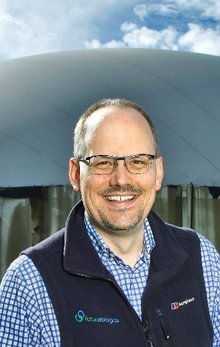
Philipp Lukas, Founder and CEO of Future Biogas, says: “As the UK forges ahead with developing carbon storage facilities such as Endurance and HyNet, the CO₂ from Moor is expected to be directed to geological sequestration, permanently removing it from the atmosphere.
“This is essential to Project Carbon Harvest: the objective of which is to move our biomethane plants beyond just renewable energy to verifiable, permanent carbon dioxide removal, i.e. removing more CO₂ from the atmosphere than the whole process produces effectively providing much-needed energy with net-negative emissions.”
Bringing renewables to the grid
According to Future Biogas, the success of Moor Bioenergy relies on the key relationship with AstraZeneca.
The plant is based on the commercial foundation of a 15-year offtake agreement with the pharmaceutical company, supporting its commitment to achieving 100% renewable energy for its operations.
This agreement, alongside similar agreements with feedstock growers and the commercialisation of captured CO₂, gives the facility commercial stability so that it can operate without being subsidised by the public.
AstraZeneca’s partnership enabled the construction of a new plant, rather than relying on renewable gas certificates.
This means that the new biomethane that is created at Moor Bioenergy is directly added into the renewable energy grid in the UK.
For corporations like AstraZeneca, this can help verify their decarbonisation claims by making a real, measurable impact through investing in new renewable energy capacity.
What needs to change for bioenergy adoption?
Moor Bioenergy was planned to be the first of many bioenergy with carbon capture and storage (BECCS) plants that Future Biogas would develop.
It has multiple new biomethane with BECCS plants in various stages of planning and development, as well as exploring the potential of retrofitting BECCS technology into its existing plants.
Each new BECCS plant in its portfolio has the potential to capture thousands of tonnes of biogenic CO₂ per year.
However, Philipp says regulations need to be updated: “Realising this vision at scale requires policy certainty.
“While a clear successor mechanism to the Green Gas Support Scheme (GGSS) would be welcome, the industry most needs grid-injected biomethane to be treated as zero-emission under the UK ETS.
“This, more than anything, would preserve biomethane’s momentum, enabling it to continue scaling towards its potential.”
Future Biogas says that it is in conversations with other large organisations like AstraZeneca, in order to emulate the success of the Moor Bioenergy project.
Like the partnership with AstraZeneca, it is aiming to help companies future-proof their decarbonisation plans while offering long-term pricing certainty.
Company portals


Executives
Philipp Lukas
Chief Executive Officer