How Fluorescent Crabs are Shedding Light on Reef Survival
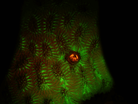
Researchers at the King Abdullah University of Science and Technology (KAUST) have discovered that tiny gall crabs have developed fluorescent camouflage to blend into their coral homes – an example of evolution in action.
This discovery not only highlights the intricacy of coral reef ecosystems but also offers valuable insights into their conservation.
Fluorescence as a tool for survival
The study, led by KAUST Marine Science PhD student Susanne Bähr, reveals that gall crabs, which are less than 1cm in size, use fluorescence to disrupt their outline and avoid detection by predators.
As coral reefs face increasing threats from climate change, understanding the roles of even the smallest species becomes vital.
Fluorescent camouflage in gall crabs may seem a minor detail, but it forms part of a much bigger picture of reef resilience.
“I want to use my research to highlight the importance of these coral-associated invertebrates and their significance for coral reef ecosystems,” says Susanne.
“They’re generally overlooked, and we need to understand how many there are, why they’re there and what they do for reef persistence and resilience.”
These elusive creatures don’t just live among the corals – they have a symbiotic relationship with them.
- A symbiotic relationship is a close and long-term interaction between two different species, where each species impacts the survival, reproduction or health of the other.
- These relationships can be beneficial, neutral or detrimental to one or both species involved.
- There are three main types of symbiotic relationships: mutualism (both benefit), commensalism (one benefits whilst one doesn't) and parasitism (one benefits at the expense of the other).
Some species inhabit open tunnels or enclosed galls formed within the coral structure with their fluorescence varying depending on the type of coral dwelling.
“I had been working with these crabs for some time, so this observation was particularly intriguing, and I started reading about fluorescence,” says Susanne.
“It’s been well studied in reef fish, which have many functions.
“However, less is known about fluorescence in crustaceans and crabs and shrimps are enormously diverse.
“So, I wondered if we could find similar patterns in crustaceans as we’ve observed in fish.”
Mapping evolutionary patterns
Over the course of the study, Susanne and her colleagues collected 286 gall crabs from 14 different genera across the Red Sea and Indian Ocean.
Using a custom imaging technique, they analysed which body parts fluoresced and to what extent.
- Bioluminescence is the production of light by living organisms.
- It's important for a variety of reasons, including camouflage, attracting mates, defense and communication.
- It also plays a vital role in deep-sea ecosystems and has various applications in scientific research, including gene therapy and biomedical research.
This morphological data was then mapped onto an evolutionary tree, built from genomic sequencing.
One notable example involves a gall crab species living in cylindrical coral pits, proving that different crab species prefer different shapes of coral.
“The back of the crab is sticking out a little bit,” explains Susanne.
“It has this striking fluorescence pattern that disrupts how the crab looks, it disguises the crab's outline so you can’t see a crab shape.”
Coral reef resilience
These findings underscore the adaptive capabilities of reef invertebrates and their critical, yet often overlooked, role in maintaining reef health.
“Gall crabs are one of the many types of invertebrates living in association with corals on tropical reefs,” says Francesca Benzoni, Associate Professor of Marine Science and Associate Director at the Red Sea Research Center at KAUST, Susanne’s supervisor.
“Much remains to be discovered on cryptic and poorly studied reef invertebrates and their fundamental biology, ecological role and the role they play in the resilience of coral reef ecosystems in the Red Sea and worldwide.”
Explore the latest edition of Sustainability Magazine and be part of the conversation at our global conference series, Sustainability LIVE.
Discover all our upcoming events and secure your tickets today.
Sustainability Magazine is a BizClik brand