Can CMA CGM & TotalEnergies Decarbonise Maritime Shipping?
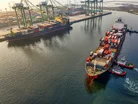
TotalEnergies and CMA CGM are agreeing to a 50/50 joint venture that brings liquefied natural gas (LNG) refuelling infrastructure to the centre of marine fuel supply in Europe.
The deal focuses on the Amsterdam–Rotterdam–Antwerp (ARA) port region and marks the first time an energy provider and a global shipping company will co-develop and operate marine refuelling logistics.

The plan to decarbonise shipping
The plan introduces a 20,000m³ LNG bunkering vessel to Rotterdam by 2028.
From supply agreements to portside operations, the project targets shipping’s transition from conventional fuels to lower-emission alternatives.
Instead of looking at vessel technology alone, this partnership turns attention to the mechanics of supply itself, how and where cleaner fuel gets to the ship.
LNG bunkering replaces traditional marine fuels with liquefied natural gas, a fossil fuel that emits up to 20% fewer greenhouse gases and cuts nitrogen oxides and sulphur oxides sharply.
These reductions benefit not just climate targets but port-side air quality.
However, LNG bunkering is only as effective as the infrastructure behind it.
Without coordinated logistics, cleaner fuels remain underused.
Coordinating marine refuelling across Europe’s busiest port
Rotterdam, the largest port in Europe, anchors the logistics model.
The joint venture, formed by CMA CGM and TotalEnergies, takes responsibility for the full LNG bunkering chain: from arrival at the Gate terminal to ship-to-ship refuelling at berth.
This is not just for CMA CGM’s vessels but for any shipping lines operating in the ARA corridor.
TotalEnergies already operates one LNG bunker ship, the 18,600m³ Gas Agility, in the region.
The new vessel will increase capacity and add flexibility.
By having two bunker ships instead of one, the partners expect faster turnaround for ships needing fuel, better schedule management and lower emissions tied to delays or inefficient fuelling windows.
"With this joint venture, CMA CGM and TotalEnergies are taking a new step to support the energy transition in shipping,” says Rodolphe Saadé, Chairman and CEO of CMA CGM Group.
"For the first time, a shipping company and an energy provider will jointly operate an LNG bunkering vessel, based in the port of Rotterdam.”
That shared operation goes beyond vessels.
The agreement is backed by a long-term fuel supply contract, binding TotalEnergies to deliver up to 360,000 tonnes of LNG each year from 2028 through 2040.
The LNG will feed CMA CGM’s growing dual-fuel fleet, expected to reach 123 vessels by 2029.
That fleet is central to the company’s net zero emissions strategy.
When blended with biomethane or synthetic methane, both renewable gas types, the carbon profile of LNG improves further.
This blend of logistics and supply stability makes LNG more practical as a transitional marine fuel.
It also means ports like Rotterdam can count on cleaner fuel throughput.
“We are proud to further contribute, alongside a partner like CMA CGM, to the development of an LNG bunkering supply chain in one of Europe’s leading port hubs,” says Patrick Pouyanné, Chairman and CEO of TotalEnergies.
“This strategic partnership not only strengthens our position as a major player in LNG bunkering but also illustrates the shared commitment of two leading French companies to actively support the energy transition.”
Why supply chains matter more than targets
Emissions reductions start with reliable delivery.
Logistics infrastructure is rarely highlighted in maritime emissions discussions, but it makes or breaks the value of cleaner fuel types.
LNG bunkering is not simply a matter of shipping gas into port.
The chain spans import terminals, storage capacity, transfer vessels, trained operators, environmental compliance and safety systems.
Each step must align in both timing and regulation.
That complexity becomes more acute when scaled.
A single misstep, delayed vessels, weather-related disruption, equipment failures, can cascade through the system.
LNG logistics must therefore be highly resilient, with spare capacity and multiple fallback options.
In Europe, LNG import flexibility has proven valuable during periods of supply instability.
LNG’s ability to be moved by ship rather than pipeline allows buyers to shift volumes in response to market or geopolitical changes.
This joint venture builds on prior work between CMA CGM and TotalEnergies.

Their partnership dates back to 2017, covering bunkering operations at Marseille Fos and Dunkirk. Both companies bring substantial infrastructure and assets into this venture.
CMA CGM’s wider logistics arm, CEVA Logistics and its air cargo network add multimodal flexibility.
On the energy side, TotalEnergies holds a global LNG portfolio of 40 million tonnes per year as of 2024, giving the capacity to support consistent marine fuel flow.
Building a scalable model for lower-emission shipping
The combined resources allow this LNG bunkering model to stretch horizontally across transport networks and vertically across the energy chain, from extraction and liquefaction to port delivery and fuelling.
For shipping lines, this integration cuts uncertainty in fuelling operations.
For port authorities, it improves traffic handling and throughput.
For energy companies, it creates efficiency in asset use while aligning with emissions policies.
LNG may not be the long-term solution for decarbonising shipping, but without reliable bunkering models, its emissions advantage cannot be realised.
As dual-fuel vessels become more common, scalable logistics like this joint venture will be essential to ensure lower-carbon fuel reaches ships on schedule and in volume.