
EcoVadis: Are US Firms Quietly Boosting Sustainability?
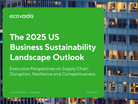
As regulatory volatility, climate disruption and geopolitical instability shape global businesses, sustainability has emerged as a strategic imperative for US corporations.
The EcoVadis 2025 Sustainability Outlook Report offers a nuanced view of how corporate leaders are navigating methods to not only stay compliant, but also gain a competitive edge.

Investing more, saying less
Despite rising political resistance to ESG regulations, most US businesses are reinforcing their sustainability strategies.
Of 400 executives surveyed, EcoVadis found that 87% have maintained or increased investment in sustainability since the beginning of 2025.
Yet a notable trend is the rise of "greenhushing".
31% of companies are investing more but promoting less and 8% have stopped talking publicly about sustainability altogether.
For many companies, sustainability has moved from branding to a core operational strategy.
As the report notes, this is no longer about values alone, but about business viability and resilience.
Supply chain sustainability
Supply chain sustainability is where the strategic value of ESG investment becomes most visible.

According to EcoVadis, 65% of surveyed executives believe sustainable supply chain practices enhance resilience and growth, helping to mitigate risks, reduce costs and build stronger brand equity.
For finance leaders, 52% see sustainability as directly supportive of long-term competitiveness, while only 19% still view it as a cost centre.
This value is particularly critical in sectors subject to due diligence regulations, with 62% of directors and 59% of C-suite leaders citing sustainability as a driver of customer retention.
The cost of deregulation
As ESG regulations come under threat, business leaders are wary of the consequences.
Nearly half (47%) of C-suite executives warn that ESG rollbacks will increase supply chain disruptions, while 41% expect higher consumer prices due to climate-related cost burdens.
“Even as the debate over business sustainability heats up, executives are focused on the reality – sustainability is what keeps supply chains running and customers on board,” says Pierre-François Thaler, Co-Founder and Co-CEO of EcoVadis.
“To stay ahead of risks and disruption, leading companies are prioritising transparency and accountability by investing in tools that help them assess supplier performance, manage risk more proactively and navigate evolving compliance demands.”
Concerns extend to inflation and labour abuses, with 39% anticipating reduced access to critical resources and 31% warning of increased worker mistreatment.
While a minority (around 25%) see deregulation as an opportunity for innovation, the consensus is that reduced oversight risks eroding accountability and data quality.
A striking 63% believe ESG rollbacks could ultimately create more sustainability risk.
Data integrity challenges
Compliance with emerging regulations remains a challenge.
Only around half of businesses report being on track to meet ESG data collection mandates for California’s SB 253 and the EU’s CSRD.
Readiness drops further for Canada’s Modern Slavery Act (39%) and the EU’s Carbon Border Adjustment Mechanism (44%).
Compounding the problem is poor data quality. One-third of executives admit to using estimates for ESG disclosures despite knowing they were inaccurate, a sign of the mounting pressure to report, even in the absence of robust systems.
A catalyst for transparency
To close data gaps and future-proof operations, US businesses are turning to technology.
ESG risk mapping tools are the most widely adopted (57%), followed by supplier engagement platforms (49%) and supply base mapping (34%).
However, only 18% are currently using tools to map Scope 3 emissions, a critical area for decarbonisation.
“Our goal is to empower companies with insights and make it easier for them to access primary supplier data exactly where they conduct their Scope 3 calculations,” comments Julia Salant, General Manager, Carbon Solution at EcoVadis.
“By expanding our ecosystem with partners, we’re helping businesses to move from industry averages to primary emissions data and seamlessly bring it into their reporting and decarbonisation efforts.”
Looking ahead, 53% of companies plan to expand their ESG tech stack within the next year.
This includes investment in carbon engagement platforms, aiming to replace shallow disclosure tools with action-oriented systems that scale with regulatory and operational demands.
The EcoVadis report concludes with a clear message: resilience is the future of sustainability.
