How are Volkswagen and Uber Redefining Autonomous Taxis?
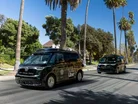
Volkswagen is continuing to accelerate its push into autonomous EVs through a strategic partnership with Uber, deploying the ID. Buzz minivan as a robotaxi solution.
This collaboration combines Volkswagen’s manufacturing strength with Uber’s global ride-hailing platform to help reshape the future of urban mobility – one that’s more connected, electric and sustainable.
A clean energy classic
The ID. Buzz is Volkswagen’s modern reimagining of its iconic Microbus, now built on the company’s Modular Electric Drive (MEB) platform.
Designed with sustainability and urban usability in mind, the vehicle features:
- A 91-kWh battery providing up to 234 miles of range
- Rapid DC charging (10–80% in 26 minutes)
- Rear-wheel and all-wheel drive variants with up to 335 horsepower
- Recyclable materials and EV-specific low-drag design.
The vehicle’s retro-inspired aesthetics are paired with advanced driver assistance systems and robust sensor arrays, making it suitable for Level 4 autonomous driving.
The ID. Buzz also features an interior optimised for shared transport, with durable finishes and flexible seating layouts.
Scaling urban robotaxi services
Hamburg is the European testing ground for the ID. Buzz Autonomous Vehicle (AV).
Around 30 of these minivans are currently operating with safety drivers under Volkswagen’s mobility brand Moia.
The project forms part of a broader ambition to integrate self-driving vehicles into public and private transport networks.
“Autonomous driving is no longer a dream of the future – by 2030, it will change the everyday lives of millions of people in Europe,” wrote Christian Senger, Member of the Board for Fully Autonomous Mobility and Transport at Volkswagen Commercial Vehicles & CEO of ADMT GmbH.
“At the same time, our solution opens up a new business area for the German automotive industry: physical AI applications used for the common good.”
In 2026, the ID. Buzz AV will debut in Los Angeles under Uber’s banner.
Unlike fixed-route services, this deployment will offer flexible, on-demand ride-pooling options, with the ability for passengers to request solo rides where needed.
Volkswagen plans to remove safety drivers in Los Angeles by the end of 2026, with European cities expected to follow suit by 2027.
Autonomous tech with sustainable infrastructure
The ID. Buzz AV is powered by Mobileye’s autonomous driving platform, using 13 cameras, 9 LiDARs and 5 radars.
This sensor suite generates five gigabytes of data per second, enabling real-time mapping and object detection.
Volkswagen’s use of in-house mapping tools and non-reliance on GPS improves resilience in unpredictable or infrastructure-poor environments.
Compared to retrofitted EVs used by other robotaxi operators, Volkswagen’s decision to produce the ID. Buzz AV on its own manufacturing lines ensures better cost-efficiency and reduced environmental impact through streamlined production.
“The ID. Buzz is Volkswagen’s next iconic vehicle for North America,” says Pablo Di Si, Former President and CEO of Volkswagen Group of America.
“It serves as our brand halo in the US and Canada and embodies the best of Volkswagen: distinctive design, fun to drive, loaded with technology, incredibly spacious and sustainable.
“It also honors the past by evoking the classic Minibus while embracing the future of our industry.
“I’d like to thank the leaders and employees throughout North America and Europe for all their hard work in getting this exciting new vehicle to market.”
An inclusive EV experience
The Uber-Moia platform is designed with safety, accessibility and inclusivity in mind.
Features include:
- NFC-enabled keyless entry via smartphone
- Cabin cameras for behavioural monitoring and object detection
- AI-assisted safety interventions, including remote communication
- Emergency stop controls for passengers.
These technologies aim to provide a safer environment for all riders, particularly women and other vulnerable groups, by offering options to avoid shared rides during high-risk hours.
Supporting autonomous ambitions
Europe has historically lagged behind the US and China in AV deployment due to stricter regulations and lack of large-scale tech platforms.
However, with new EU initiatives creating regulatory sandboxes and test zones, projects like Volkswagen’s ID. Buzz AV are helping Europe stake a claim in the evolving mobility ecosystem.
Through this Uber partnership, Volkswagen is also reinforcing the economic sustainability of autonomous transport.
By sharing AV infrastructure costs across its family of brands, including Audi and Porsch, the company is reducing development costs and improving scalability.
By replacing privately owned vehicles and combustion-engine taxis with zero-emission, autonomous alternatives, Volkswagen and Uber are demonstrating that sustainability can be both scalable and customer-centric.
As cities seek smarter, cleaner transport solutions, partnerships like this one between Volkswagen and Uber are key to enabling that transition.
With the ID. Buzz at its core, this initiative signals a new era where environmental responsibility, technological innovation and urban mobility intersect.