
How Team Brady Won On & Off the Water in E1's 2025 Series
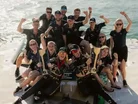
Team Brady has secured both the 2025 E1 World Championship and the inaugural Blue Impact Championship, marking the first time the all-electric powerboat racing series has recognised environmental performance alongside competitive results.
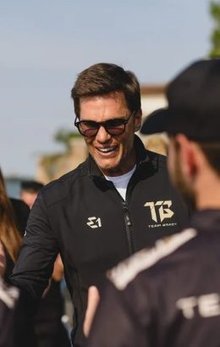
Now in its second year, the story of E1 so far has largely been written by Tom Brady (seven-time Super Bowl winner) and his crew, who also claimed victory in the 2024 series.
As a sporting event focused on cutting-edge EVs, E1's organisers have always regarded sustainability as central to their sport, but the creation of the Blue Impact Championship has helped the teams find another gear entirely.
Now, all nine teams (all of which are backed by celebrity sportspeople, including LeBron James, Rafael Nadal and Tom himself) are directing their competitive spirits towards ecocentric goals as well as the races, pushing one another to new heights of sustainability.
This year, the Blue Impact Championship was presented by Bombay Sapphire and assessed each of the teams on their season-long contributions to protecting and restoring aquatic ecosystems.
Team Brady's winning entry centred on its Race for Change programme, wherein they committed to collecting 100kg of plastic from the ocean for every point they scored across the seven races.
After topping the league table with 195 points, Team Brady successfully removed almost 20 tonnes of plastic from the seas with the help of 4ocean Foundation.

Performance-linked environmental impact
Team Brady's commitment to collect 100kg of waste per point was not plucked from the sky.
Co-Team Principals Ben King and Joe Sturdy knew that the 100 kilos is the average amount of plastic waste that a person generates each year, so they agreed that this initiative could offset the waste of a huge group of people while also raising awareness of the scale of the plastic problem.
This was just Team Brady's programme, though; the projects of other crews spanned areas including the conservation of coral reefs and the protection of marine biodiversity.
When it came to selecting a winner, E1 formed a jury of sustainability leaders from Bacardi, the One Ocean Foundation, Oceans2050 and the MSC Foundation, all of whom evaluated the teams across criteria including measurable impact on local communities and ecosystems, stakeholder collaboration and programme creativity.
The teams were also assessed on their ability to engage fans and partners to inspire wider environmental action.
Beyond the race
Tom's goal for the team has always been to succeed both on and off the water.
"When we first set out to build the team with team principals Ben and Joe, our goal was to win both on and off the water – and we've done exactly that," he says.
"Our Race for Change platform has been a driving force for real environmental impact, and it was important to all of us that our commitment went beyond words."
This season, Team Brady built partnerships with WaterAid, OceanR and the 4ocean Foundation that stood them in good stead to compete on the sustainability front.
OceanR provided eco-friendly uniforms for the crew, producing racing kits and tracksuits made using recycled plastic bottles.
WaterAid, which is set to play an even larger role in Team Brady's operations from next season, helped the crew to raise awareness of access to clean drinking water around the world.
Sam Coleman, one of Team Brady's two pilots, sees the environmental outcomes of his work as equally important to the racing.
"Delivering tangible environmental change alongside sporting success is something I'm extremely proud of, and I hope we can make an even greater positive impact in the 2026 season," he says.
Judging sustainability in sport
The Blue Impact Championship represents E1's attempt to embed environmental responsibility into the competitive structure of electric powerboat racing, which, by its very nature, is dependent on healthy marine ecosystems.
To ground the sport in sustainability, E1's organisers brought in Carlos Duarte to be Chief Scientist. Carlos sees plastic pollution as one of the most pervasive human impacts on our oceans.
As such, he has a great deal of admiration for Team Brady's extra-curricular work this year. "Team Brady's initiative sets a benchmark for what truly purpose-driven racing can achieve," he says.
"The Blue Impact Championship is the component of E1 where, regardless of who wins, we all win, as the collective actions of all teams are an impressive example of the potential of sports to drive meaningful, positive impact on our waters."
The award was presented at Bombay Sapphire's Laverstoke Mill distillery – an appropriately sustainable location. The plant, located around an hour outside of London, holds an 'Outstanding' BREEAM rating and recycles or converts more than 99% of its waste into energy.
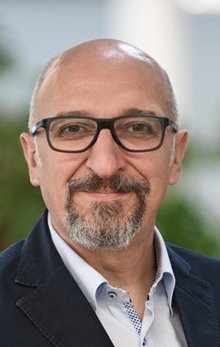
Rodolfo Nervi, Vice President of Corporate Sustainability, Global Safety & Quality for Bacardi (which owns Bombay Sapphire), sits on the Blue Impact jury and emphasises the alignment between the gin brand's sustainability commitments and E1's environmental mission.
"At Bombay Sapphire we take real action to help protect the planet, from sourcing all 10 botanicals from sustainably certified suppliers to achieving Wildlife Habitat Council Certification for our work to protect biodiversity at the distillery," he explains.
Turning sustainability into a competition
Team Brady's double championship win demonstrates that competitive success and environmental impact need not be mutually exclusive in professional sport.
The team's performance-linked plastic removal programme offers a replicable model for other racing series seeking to integrate sustainability metrics into their competitive structures.
One thing is for sure: turning sustainability into a competition between notoriously competitive athletes can only be a good thing for the planet
Company portals


Executives
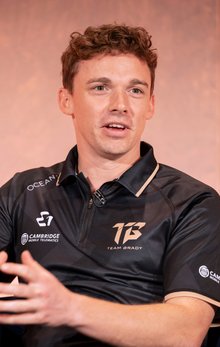
Ben King
Co-Team Principal
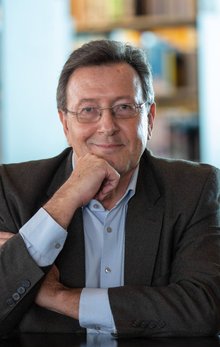
Carlos Duarte
Chief Scientist
Joe Sturdy
Co-Team Principal
Rodolfo Nervi
Vice President of Corporate Sustainability, Global Safety & Quality
Tom Brady
Owner