
Orbia’s £1.4m Graphite Recycling Plant for a Low CO₂ Future
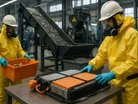
Despite its name, a lithium-ion battery contains a lot more graphite than lithium, according to Orbia.
This is due to the graphite being used in the anode to store lithium ions, the company says, “graphite makes up about 30% of a lithium-ion battery’s weight.”
To tackle this, Orbia’s Fluor and Energy Materials (FEM) business has secured a £1.4m (US$1.87m) grant from the UK Government to establish the country’s first graphite recycling project.

A circular economy for a low-emission future
With rising EV demand, renewable energy and storage components, and increased digitalisation, graphite is essential for the energy transition.
The UK project is set to support the domestic battery supply chain and advance the circular economy.
The recycling centre is part of the UK’s £4bn (US$5.4bn) DRIVE35 programme, being delivered by the Department for Business and Trade in partnership with the Advanced Propulsion Centre UK and Innovate UK.
Ultimately, the partnership aims to accelerate R&D in the automotive industry and increase scale for a low or zero-emission future.
Today, graphite faces critical supply and demand issues; by 2035, global graphite demand is projected to outpace supply by roughly 2.3 million tonnes.
The UK’s investment aims to reduce reliance on overseas supply chains, especially in regions like China, which supplies 95% of the world’s natural and synthetic graphite.
“This investment marks a significant milestone in enabling a huge step toward building a domestic, circular supply chain for battery materials and supporting the UK’s transition to a more sustainable, zero-emission future,” says John Jaddou, Global Director, New Business Development at Orbia FEM.
“It also lays the foundation for the creation of highly skilled jobs that are critical to electrified mobility, circularity and long‑term decarbonisation.
“By leveraging decades of industrial and process expertise in complex fluorine-based chemistries at scale, Orbia is uniquely positioned to demonstrate that graphite recovery can be both technically robust and commercially feasible, laying the groundwork for a future industrial-scale facility.”
Graphite and critical mineral recycling
According to Orbia, most graphite is sent to landfill or incinerated, resulting in material waste and CO₂ emissions.
By 2030, it is estimated that more than 236,000 tonnes of graphite could be available for a circular life annually, generating a US$2.6bn market opportunity.
Sustainability leaders won’t want to miss Sustainability LIVE: The Leadership Summit at London Climate Action Week, taking place at Code Node on 25 June 2026.
Register now for this exclusive invite-only event.
Natural graphite requires mining, grading and extensive processing, while synthetic graphite, made from petroleum by-products, is produced via high temperature graphitisation (up to 3,000°C), consuming massive energy and emitting substantial CO₂.
Orbia’s FEM business has developed a proprietary technology to recover, purify and upcycle graphite from domestic feedstocks.
The process focuses on graphite extracted from “black mass residue”, the powder generated after end-of-life batteries are shredded and valuable metals such as lithium, nickel and cobalt are removed.
Using a multi-step purification method that incorporates hydrofluoric acid, Orbia refines the recovered graphite to meet physical and chemical standards required for battery anodes.
The result is ultra-high-purity upcycled graphite that performs comparably to virgin material.
“The projects announced demonstrate the UK’s determination to lead the shift to zero-emission mobility,” says Ian Constance, CEO at Advanced Propulsion Centre UK.
“By facilitating the UK Government’s DRIVE35 grants, we are turning world-class innovation into industrial capability.
“With our partners in DBT and Innovate UK, we are backing manufacturers, empowering SMEs and strengthening the UK’s sovereign supply chain.
“This multi-million-pound support package is more than an investment in technology; it is an investment in the people, skills, and companies that will define the future of clean transport.
“Together, we are building the foundations of a competitive, resilient and sustainable automotive industry.”
Supporting large-scale commercialisation
A major advantage of Orbia’s technology is its commercial viability.
The UK project is set to operate at kilogram-scale batches, serving as a key foundation for a future large-scale industrial plant.
Orbia’s multi-phase project is in the planning stage and is expected to begin early 2026; installation and outputs are expected in late 2026.
The company also brings established UK-based research and development capabilities through its Energy Materials Business Unit, with a dedicated technology centre in Chester.
The site plays a central role in advancing battery materials innovation, including electrolyte and solvent system development, Li-ion battery prototyping and testing and inorganic materials research.
Traditionally, graphite recycling has been uneconomical because graphite carries a lower market value than other battery materials like lithium, nickel and cobalt.
Orbia’s innovation changes that dynamic by enabling recycled graphite to compete cost-effectively with virgin graphite while also offering a significantly lower carbon footprint.
Preliminary assessments by Orbia’s sustainability team indicate that its recycled graphite could generate up to four times less CO₂ than synthetic graphite and up to two times less CO₂ than mined natural graphite.
To support large-scale commercialisation, Orbia is building a fully circular supply model in collaboration with leading OEMs and battery cell manufacturers.
Through these partnerships, the company aims to return upcycled graphite directly into customers’ supply chains for use in batteries and other automotive applications, helping advance their net-zero goals.
Company portals
Advanced Propulsion Centre UK
Orbia
Orbia Fluor & Energy Materials
UK Government




Executives

Ian Constance
CEO

John Jaddou
Global Director, New Business Development