Q&A: VINCI’s Isabelle Spiegel on Sustainable Infrastructure

The built environment has a central role in both climate adaptation and boosting sustainability efforts globally.
Full of impermeable, heat-absorbing surfaces, vehicles and dense populations, urban areas both cause, and suffer greatly from, the changing climate. But they can also play a more active role in advancing sustainability efforts and give back to nature.
VINCI’s sustainability strategy focuses on reducing carbon emissions and has already lowered Scope 1 and 2 emissions by 26% since 2018 and Scope 3 emissions by 4% since 2019.
The French multinational considers how to use resources more efficiently and tries to select sustainable materials. For instance, 46% of its electricity now comes from renewable sources, while 32% of the concrete it uses is low-carbon.
The company also works to protect ecosystems by using ecological engineering and reducing soil sealing.
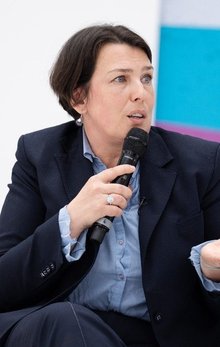
Isabelle Spiegel, the Vice President in charge of Environment at VINCI, joined the Sustainability LIVE: Leaders Summit as part of London Climate Action Week in June to discuss how the construction and infrastructure sector was taking up the sustainability mantle and using infrastructure in a more climate-positive way.

In a sector as complex as VINCI's, where do you see the opportunities?
What really matters in the environment and sustainability is that every person should be able to take action. And what really matters is that solutions are coming from the ground, from the field, from every single person. That's the way we need to innovate. We need to develop solutions and scale up existing solutions that make sense at the local level.
Sustainable innovation: that's really how to make sure that we mobilise enough. We did it by first launching a prize, an internal environment award, and we got really great responses from everybody. We are up to 1,000 solutions coming from our own people.
The tricky part is making sure they can be scaled up. That's why we launched another programme to make sure we can duplicate these different innovations.
What are those innovations that you're harnessing at the moment?
The top one—and it's great because we are in the middle of a heat wave in Europe—is about creating cooling islands in cities—bringing nature back into cities. And the core of this is four technical levers:
- One is the soil. We need to bring back living soils within cities.
- There is nature and vegetation by itself.
- There is the colour and the type of asphalt you use.
- But there's also the fact that we need to disconnect stormwater from the networks and make sure we re-infiltrate stormwater directly into the vegetation and soil.
That's one of our solutions that won the grand award two years ago and we are now scaling it up with more than 100 projects.
Supply chain and materials like concrete and steel are a massive hurdle. What progress is VINCI making in driving a more circular economy when it comes to materials like that?
We started seven years ago by setting a strong target on low-carbon concrete because we need to reduce the carbon footprint of concrete. And by doing that, one lever is to substitute one part of the cement with circular materials.
So, it could be waste from other industries—from steel, from energy power supply, for instance. And that's a way to combine carbon and circularity into one solution.
Our target is to achieve 90% low-carbon concrete across all VINCI construction projects by 2030, which is very ambitious. We started in France – we are already up to two-thirds of low-carbon concrete, so it's working.
A core theme of this year’s London Climate Action Week is water positivity. It is often discussed in consumer goods and food and beverage, but what does it look like in that heavy infrastructure space?
To me, it was really important to say that we have skills in infrastructure because we help build water networks. And so water infrastructure already exists. Indeed, we also have a role to play in bringing solutions.
How then to disconnect the stormwater from networks to make sure that we manage to re-infiltrate into the soil and go back to groundwater to store water, for instance? But it's also about solutions for what we can call the reuse or re-utilisation of wastewater to avoid the use of drinkable water.
We have nice solutions coming from that: we use wastewater from the municipality near our airport, for instance, to feed the airport's sanitary water. That is avoiding drinkable water and this kind of solution moves toward water positivity.
Throughout your 20-year career in the sustainability and environmental consultancy space, how do you think people's attitudes have changed towards the climate crisis?
I see changes every two or three years, more or less.
What's happening now is that we have a strong reconnection between economic impact and the need to secure energy supply, critical material supply, etc., and, at the same time, environmental and social considerations.
And this kind of change, for me, is what makes it so powerful when you are in board-level discussions. It's about making sure your business remains in continuity, taking care to account for these environmental and social impacts as well.
Company portals

Executives
Isabelle Spiegel
Executive Committee Member