
Why Udinese’s Bluenergy Stadium is One of Europe’s Greenest
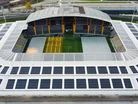
While Udinese Calcio may not fly as high as Italy’s footballing giants on the pitch, the club is well and truly leading the way off it.
The historic club has received the De Sanctis Award for Sustainability, with its home ground, the Bluenergy Stadium, recognised for its environmental innovation.
The ceremony took place at Palazzo Chigi in Rome on 26 November in the presence of Italy's Minister for the Environment and Energy Security, Gilberto Pichetto Fratin, and Italian Football Federation President Gabriele Gravina.
Italian football legend Dino Zoff presented the award to Magda Pozzo, the club’s Chief Commercial Officer.
"This is a historic day for our club," Magda said.
"Being recognised at Palazzo Chigi for our sustainability model is a proud moment for Udine, Friuli Venezia Giulia and for Italy.
"The Bluenergy Stadium is more than an arena – it is a European laboratory for innovation, responsibility and the future of sport."
Udinese’s solar array
The stadium's large-scale solar installation features 2,409 panels covering 4,615 square metres across the roof.
The system can generate around 1.1 million kilowatt hours annually, producing far more than the 770 MWh consumed by the facility itself.
Around 70% of the generated energy powers the stadium, while the remaining 30% feeds into a renewable energy community launched in 2024.
This community, called "Energia in Campo", is the first of its kind linked to a football stadium in Italy.
Local businesses and supporters have been encouraged to join the scheme to share their surplus energy, with incentives directed toward a social project supporting the Child Neuropsychiatry facility at Friuli Centrale University Health Authority, which treats eating disorders in young people.
Bluenergy’s role in the construction
Since 2018, Udinese’s home ground has been known as the Bluenergy Stadium, after the energy company became one of the club’s primary sponsors.
The deal between the Serie A club and Bluenergy hasn’t just been about marketing, though, as some sponsorship deals are.
Instead, the Italian energy firm has become closely involved in the club’s electricity consumption, providing it with 100% renewable energy.
All in all, this arrangement has led to a reduction of around 6,500 tonnes of CO₂ emissions.
Now, the club will be able to produce all the energy it needs on site, making things even more sustainable and cost effective.
The solar park, which sits atop the roof and around the grounds of the Bluenergy Stadium, was developed with support from the Polytechnic University of Milan, whose researchers served as energy advisors throughout the construction.

The importance of recognition
Each year, the De Sanctis Foundation organises the award in collaboration with the Ministry of the Environment and Energy Security, under the patronage of the Presidency of the Council of Ministers.
Udinese also participates in UEFA's European Club Association sustainability working group and is a signatory to the UN Football Climate Pact.
In 2023, research firm Brand Finance ranked the stadium as the fourth most sustainable in the world and first in Italy.
Magda highlighted the role of the ECA sustainability working group as particularly influential in the club's approach.
The stadium, designed by Studio Casamonti and opened in 2016, hosts 25,132 spectators and was selected to stage the 2025 UEFA Super Cup in August between Paris Saint-Germain and Tottenham Hotspur.
Before that match – perhaps the highest profile game ever played at the arena – Magda spoke about the importance of sport's influence in the realm of sustainability.
“Football has a unique power of influence, with over two billion followers in the world, so why not use it when it has such a great influence and audience to get the message of sustainability across?” she asks.
"Football needs to be a source of inspiration for future generations."
Company portals

Executives

Magda Pozzo
Chief Commercial Officer