
WWF Q&A: World Oceans Day, Marine Protection & Finance
World Oceans Day serves as a global platform to raise awareness of the vital role oceans play in sustaining life on Earth, bringing together governments, businesses, communities and individuals to promote ocean conservation and the sustainable use of marine resources.
Among the leading voices advocating for ocean protection is Kirsten Schuijt, Director General of WWF International, who has spent her career working across conservation, sustainable development and environmental leadership.
Since becoming Director General of WWF International in 2023, Kirsten has overseen the organisation's global efforts to address biodiversity loss, climate change and the degradation of critical ecosystems, including the world's oceans.
Her work highlights the importance of protecting marine biodiversity, restoring ocean health and strengthening the connection between nature, economies and communities. She has also championed the role of sustainable finance, locally led conservation and international cooperation in delivering long-term environmental solutions.
Through WWF's global initiatives, Kirsten has helped advance efforts to protect and restore critical marine habitats, improve the status of marine species and support coastal communities whose livelihoods depend on healthy oceans.
Kirsten shares her insights with Sustainability Magazine ahead of World Oceans Day.
What is World Oceans Day and why is it significant?
World Oceans Day is globally about awareness-raising.
We have days throughout the year like World Oceans Day, World Wildlife Day and World Freshwater Day that are a really great opportunity to mobilise people, corporates and governments around what is an absolutely essential ecosystem: the oceans.
It's also about reminding people that the ocean isn't just a beautiful ecosystem, but that it is essential and underpins a healthy planet, our economy and how important it is for future life on Earth.
As for me personally, I love the oceans.
What I find interesting about our parts of the world is that for many years we looked at the oceans as something that's so utilitarian.
It's like this grey piece of water that we use for shipping lanes, electricity cables, fishing and wind farms and a day like World Oceans Day is also to show how that ocean is so much more than just an economic highway.
It's something that we really deeply care about and contains life.

How are businesses are affected by the decline in ocean health?
Businesses are hugely affected all over the world, no matter where you sit, whether it's the big multinational companies or small-scale businesses in many of the coastal places.
There's around 60% of companies that are listed that are actually dependent on oceans and are directly impacted by the loss of ocean biodiversity, that is a massive amount.
Companies depend on oceans, they produce a lot of goods like fish, but also oceans produce a lot of services.
For example, coral reefs are essential in safeguarding coasts against climate change and especially sea-level rise or big storms, they protect a lot of businesses as well, especially local businesses against the impacts of climate change.
And then of course we've got mangroves and wetlands that are along the coast as well, ocean protection is hugely important in terms of impacting businesses.
Small-scale businesses all along the coasts, all over the world, communities have small-scale businesses that are a massive source of their livelihoods.
It's the big companies that we're also working with to really change their behaviour and recognise the impact and the value of oceans on their business, but also on the world.
Do you believe finance systems can help in ocean and ocean biodiversity restoration?
For WWF, finance has become one of our top priorities globally, which a lot of people don't know because they see us as a biodiversity and a species conservation organisation.
We have elevated finance to be one of our top priorities globally for WWF to impact because it's important.
We're looking at two things: greening finance and financing green.
Financing green is about raising money for the protection and conservation of oceans and other ecosystems, but it's the redirecting of financial flows, the greening of finance, that is really interesting as well.
Just by redirecting 7.7% of the world's negative financial flows, taking into account subsidies and negative investments from banks, pension funds and other financial institutions, we can bridge the funding gap that we need to protect the world's oceans.
When you look at agriculture and land, we've been fighting for decades to redirect agricultural subsidies towards more positive agricultural practices.
In the ocean space, approximately a year ago, we marked the WTO Fisheries Subsidies Agreement, that is a huge opportunity that we have right now to put our action where countries put their signatures, to translate into action that we can redirect a lot of the negative subsidies in fisheries into more positive ones.
That's what's great about ecosystems more generally, but especially about the oceans and fisheries: they're so resilient and fish stocks do come back.
Earlier this year I was at Davos and I would say the conversations with the financial sector were probably some of the most exciting ones, also because they're noticing it in their investments.
The challenge with the financial sector at this moment is: how do we measure biodiversity and get it on the balance sheet?
What are WWF's biodiversity goals and how are they preventing ecosystem loss?
The Roadmap 2030 a few years ago to focusses on biodiversity conservation including species, forest, freshwater and oceans, but then also looking at tackling the biggest drivers that cause that loss, which is finance, food and transforming energy systems.
Our last goal, which is really important, focuses on communities and locally-led conservation on the ground through communities.
With the ocean's biodiversity goals, we're looking at three things:
- Protecting and restoring critical habitats
- Enhancing marine protected areas, coral reef protection and more
- Improving the status of marine species.
We're also talking about fisheries and turtles and launching the Blue Corridors initiative, which is really focusing on protecting the migratory routes of whales in Latin America and the Pacific, and also seeing if we can expand that to Africa and Europe.
Just focusing on protection and conservation is not enough.
What does the future of oceanic biodiversity and conservation looks like?
We've got three huge opportunities and they're interlinked.

Our number one opportunity is that we have the Kunming-Montreal Declaration, the Global Biodiversity Framework, and one of the main goals is to protect 30% of biodiversity and ecosystems by 2030.
That's a huge opportunity but the question is, how do we translate that again into action?
Lots of countries signed, but we have the CBD COP coming up in Armenia and we're quite critical in seeing how much progress has been made.
The second one came out around the same time as when the WTO Fisheries Agreement came into force, the High Seas Treaty, and that is one that we've spent two decades on.
It directly contributes to the 30 by 30 and is a legally binding framework that will hopefully manage about two-thirds of the world's oceans, which is outside national jurisdiction.
The third one where we see huge opportunities is really working on the ground with communities.
Locally-led conservation and inclusive conservation are probably one of the biggest opportunities that we see in the places where we work.
WWF works with thousands and thousands of fishing communities and other coastal communities all over the world to make sure to support them that their local fishing practices are sustainable.
We're supporting them in setting up ventures to attract capital.
It's great that we're working with the big financial institutions, but if they don't have sustainable projects or programmes to invest into, then we're not really solving the problem.
Working directly on the ground with communities, which WWF does in setting up this venture fund (the SWIO Venture Builder) is really exciting and working with coastal entrepreneurs to develop sustainable blue economy businesses that can actually attract financial investments from all over the world.
An example is in the Northern Mozambique Channel, which is one of the most biodiverse places all over the world, but also in Africa and we have about 35% of the Indian Ocean's biodiversity just in this part of the world.
In Mozambique we're setting up a regional financing platform and facility together with governments, businesses and local communities to attract financial capital and help mobilise investment at scale to support oceans protection and conservation and improve governance.
Company portals
Executives
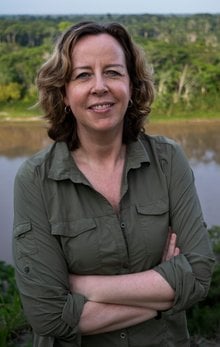
Kirsten Schuijt
Director General at WWF International