Top 10: Brands Leading the Circular Economy
The state of global circularity has fallen according to Deloitte’s Global Circularity Gap Report 2025.
It says that just 6.9% of materials entering the global economy are secondary.
Circularity not only protects the environment by reducing consumption, but can also help to lower costs through resource efficiency and strengthen supply chains.
Sustainability Magazine has ranked the Top 10 brands from a range of industries leading the circular economy.
10. Nike
Senior Director, Global Sustainability: Scott Vitters
Headquarters: Oregon, US
Founded: 1964
Employees: 79,000
Since the 1990s, Nike’s Reuse-A-Shoe programme has recycled about 148 million pounds of worn-out trainers into Nike Grind material for playgrounds, tracks and new products.
It has expanded on this with the Recycling + Donation initiative that takes back both footwear and apparel for donation or recycling.
Nike also uses recycled materials in its products, such as Flyleather which is made with at least 50% recycled leather fibres and Nike Air soles made from at least 25% manufacturing waste.
9. Michelin
Chief Sustainability Officer: Antoine Sautenet
Headquarters: Clermont-Ferrand, France
Founded: 1889
Employees: 114,000

Michelin has set a target that by 2050, 100% of the materials in its tyres will be sustainable. By 2030 it aims to bring this to 40%, up from around 30% in 2024.
The company has already successfully created tyres that use 60% renewable or recycled materials.
For nearly a century, Michelin has been retreading tyres to get more miles out of the same materials. Once tyres reach end-of-life, the company uses techniques like pyrolysis to recover materials like carbon black and steel.
8. Suntory
Chief Sustainability Officer: Masaaki Fujiwara
Headquarters: Osaka, Japan
Founded: 1899
Employees: 40,000
Suntory has a group-wide policy to make all PET bottles 100% recycled or plant-based by 2030, eliminating virgin fossil-based PET.
As of 2024, 58% of Suntory’s PET bottles met this criteria in Japan and 23% overseas.
The company engages in bottle to bottle horizontal recycling that turns old PET bottles into new ones and has developed new, lower impact recycling techniques to improve this.
Suntory is also using label-free PET bottle products so consumers do not have to remove labels before recycling.
7. Toyota
Chief Sustainability Officer: Yumi Otsuka
Headquarters: Toyota, Japan
Founded: 1937
Employees: 383,000

In Europe, Toyota has established a circular factory programme to process end-of-life vehicles.
At its Burnaston plant in the UK, the company aims to recycle around 10,000 vehicles each year and give new life to more than 100,000 parts.
Leon van der Merwe, Vice President of Circular Economy at Toyota Motor Europe, says: “We’re not stopping at our own facilities - we are eager to collaborate with other organisations who share our passion of circularity and commitment to carbon neutrality.”
6. Google
Chief Sustainability Officer: Kate Brandt
Headquarters: California, US
Founded: 1998
Employees: 183,000
In its data centres, Google has achieved an 86% landfill diversion rate by reusing and recycling equipment on a massive scale.
For example, Google’s server remanufacturing programme means 36% of replacement servers deployed in 2016 were remanufactured machines. The company resold more than 2.1 million units of retired components to other organisations in a single year
Google also designs its hardware with circularity in mind, with servers custom-built to be repairable and upgradeable and recycled materials in its consumer products.
5. Apple
VP Environment, Policy and Social Initiatives: Lisa Jackson
Headquarters: California, US
Founded:1976
Employees: 164,000

Daisy is a cutting-edge disassembly robot designed by Apple that can recover materials from 1.2 million iPhones per year.
In 2022 , a machine named Taz followed that uses shredder-like technology to separate magnets and recover more rare earth elements.
A third robot, Dave, disassembles Taptic Engines to recover tungsten, steel and magnets.
Lisa Jackson, Apple’s VP of Environment, Policy and Social Initiatives, says: “Our rapid pace of innovation is already helping our teams use today’s products to build tomorrow’s, and as our global supply chain transitions to clean power, we are charting a path for other companies to follow.”
4. AB InBev
Chief Sustainability Officer: Ingrid De Ryck
Headquarters: Leuven, Belgium
Founded: 2008
Employees: 140,000
AB InBev says that 100% of its packaging will be returnable or made from majority recycled content by 2025. In FY24 it reported achieving 89.8% of this goal.
It created EverGrain to capture more value from barley, upcycling brewers’ spent grains. It creates ingredients that can improve products’ taste, aroma and texture while getting more use out of the raw material.
The company has also introduced intelligent reverse logistics software Green Mining to optimise waste collection.
3. L'Oréal
Chief Corporate Responsibility Officer: Ezgi Barcenas
Headquarters: Paris, France
Founded: 1909
Employees: 90,000

By 2025, L’Oréal aims for 100% of its plastic packaging to be refillable, rechargeable, recyclable or compostable, and 50% of plastics it uses to be recycled or bio-sourced. It aims for this figure to rise to 100% by 2030.
In June 2025, it launched the cross-divisional campaign #JoinTheRefillMovement across luxury, mass, professional and dermatological brands to make refills more mainstream.
It is deploying refill stations and fountains alongside pouches and pods for haircare, skincare, makeup and fragrance.
2. Unilever
Chief Corporate Affairs and Communications Officer: Michael Stewart
Headquarters: London, UK
Founded: 1929
Employees: 115,000
Unilever aims to cut virgin plastic 30% by 2026 and 40% by 2028 alongside making 100% of its plastic packaging reusable, recyclable or compostable by 2030 for rigids and 2035 for flexibles.
By April 2024, Unilever had reduced virgin plastic 18% against 2019 and grown recycled plastic to 22% of its global plastic packaging portfolio. Around 72% of its portfolio is technically recyclable, though just 53% is recycled at present.
The company has run more than 50 refill pilot projects since 2018 and shared its findings to both support other organisations and regulatory change.
Unilever founded the CIRCLE Alliance with USAID and EY, a US$21m programme supporting entrepreneurs to scale circular solutions across the plastics value chain. It co-chairs the Business Coalition for a Global Plastics Treaty and calls for mandatory, well-designed EPR schemes, harmonised reuse standards and global rules to close the recycling gap.
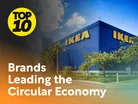
1. IKEA (Ingka Group)
Chief Sustainability Officer: Karen Pflug
Headquarters: Leiden, the Netherlands
Founded: 1943
Employees: 160,000

Ingka Group, the largest IKEA franchisee, aims to invest €1bn (US$1.1bn) in companies that are increasing recycling infrastructure.
The company estimates that since 2017, companies in its Circular Investments portfolio have recycled around 1.9 million tonnes of materials.
It is scaling as-is and buy-back programmes across its stores and provided more than 25 million free assembly parts to 2.2 million customers in 2024 to support repairs and keep products in use for longer.
Its IT recycling partnership in 16 countries has resulted in 29.7% of its end-of-life equipment being refurbished and resold and 70.3% being recycled.
In Canada, Ingka ran a campaign advocating removal of sales tax on second-hand goods, offering 13% discounts to IKEA Family members to offset the tax on As-Is items.
IKEA’s EU manifesto calls to reframe waste policy into a “Resource Framework Regulation”, harmonise Extended Producer Responsibility and invest in pan-European recycling infrastructure to accelerate reuse, repair, recycling and remanufacturing.
Company portals









Executives
Dr. Antoine Sautenet
Chief Sustainability Officer
Ezgi Barcenas
Chief Corporate Responsibility Officer
Ingrid De Ryck
Chief Sustainability Officer
Karen Pflug
Chief Sustainability Officer
Kate Brandt
Member Board of Trustees

Lisa Jackson
Vice President, Environment, Policy and Social Initiatives
Michael Stewart
Chief Corporate Affairs and Communications Officer

Scott Vitters
Senior Director, Global Sustainability

Yumi Otsuka
Senior General Manager for Sustainability Management