Behind Mars & Berry Global’s 100% Recycled Plastic Jars
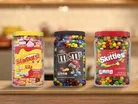
Mars, the company behind M&M’s, Skittles and Starburst, has joined forces with Berry Global to transition its widely recyclable pantry jars to 100% recycled plastic.
As a company focussed on reducing its environmental impact, this initiative could go a long way towards reducing virgin plastic usage across Mars’ packaging portfolio.
It also represents a broader move within the industry towards circular economy practices.

A step forward for sustainable packaging
Mars and Berry Global first introduced recycled content in their packaging in 2022, incorporating 15% recycled plastic into pantry jars.
This 100% recycled iteration eliminates more than 1,300 tonnes of virgin plastic annually, the equivalent weight of 238 African elephants.
This change aligns with Mars’ broader efforts to reduce unnecessary plastic, redesign packaging and develop recycling infrastructure.
The newly designed jars, available in 60-ounce, 81-ounce and 87-ounce sizes, are manufactured using post-consumer resin, sourced from discarded plastic from curbside collections.
This process ensures that plastic waste is repurposed instead of ending up in landfills.
These already-recycled jars can be recycled again after use.
How collaboration is driving change at Mars
The partnership between Mars and Berry Global dates back to 2017 and has focused on developing sustainable packaging solutions that maintain product quality and aesthetics.
The transition to 100% recycled plastic builds on this relationship, leveraging Berry Global’s material science expertise.
"As companies across the globe commit to transitioning to a circular economy, the ability to deliver products made with recycled materials at scale is crucial," says Peter Goshorn, Vice President of Food, Beverage & Spirits at Berry Global.
"That’s why we’re collaborating with leading brands, like Mars, to significantly increase the use of recycled content to drive responsible business growth without compromising performance or aesthetics."
Mars’ sustainability strategy includes rethinking packaging design to ensure it is reusable, recyclable or compostable.
The company has committed to redesigning 12,000 packaging components as part of this initiative.
According to Allison Lin, Global Vice President of Packaging Sustainability at Mars, the move to recycled content is just one part of a broader strategy.
"In the world we want tomorrow, no packaging becomes waste, but is instead reused, recycled or composted," Allison says.
"That’s why we continue to rethink our approach to packaging and collaborate with companies like Berry.
“Reducing our virgin plastic usage by investing in recycled content is an important step in our strategy, alongside initiatives to remove unnecessary packaging, explore reuse models and redesign our packaging for circularity."
In the world we want tomorrow, no packaging becomes waste, but is instead reused, recycled or composted.
Scaling recycled plastic solutions
Recycling is not a simple process.
However, the use of post-consumer resin in large-scale production shows that recycled materials can feasibly be used in complex supply chains like Mars’.
By proving that mechanically recycled plastic can meet food-grade standards, Mars and Berry Global are setting a precedent for other companies looking to reduce their reliance on virgin plastic.
Consumer participation is also key to the success of such initiatives.
The recyclability of these jars means that once used, they can be processed into new products, reinforcing the closed-loop system that sustainability advocates are pushing for.
Mars’ decision to shift its packaging to fully recycled plastic reflects a broader trend in the consumer goods industry.
Major brands are facing increased pressure to address plastic waste, with regulatory frameworks and consumer expectations driving more ambitious sustainability commitments.
“With average global temperatures exceeding 1.5°C above pre-industrial levels for the first time in 2024, it is imperative that we continue to perform on our promises and in doing so prove that sustainability is good for business,” says Alastair Child, CSO of Mars.
Explore the latest edition of Sustainability Magazine and be part of the conversation at our global conference series, Sustainability LIVE.
Discover all our upcoming events and secure your tickets today.
Sustainability Magazine is a BizClik brand