ERM: How Businesses Align Sustainability with Resilience
From escalating trade disputes to shifting investor pressures and changing climate targets, 2025 is proving to be a defining year for corporate sustainability.
Around the world, businesses are having to evolve and change their sustainability goals to align with what the world needs.
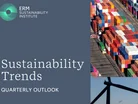
ERM’s 2025 Q1 Sustainability Trends Quarterly Outlook explores private-sector sustainability across industries.

Global trade and supply chains
Rising trade barriers, driven by sweeping US tariffs and retaliatory measures from countries including China, Canada and the EU, are creating widespread disruption across global supply chains.
This has led to rising input costs, slowed consumer confidence and strategic recalibrations.
Companies like Apple and Novo Nordisk are diversifying manufacturing locations and investing in domestic capacity, while others like Walmart are pressuring suppliers to lower prices despite regulatory friction.
The US clean energy sector is particularly exposed.
The report highlights that more than 90% of lithium-ion battery imports are coming from China, meaning the impact of tariffs on solar and storage sectors could be significant.
ERM is advising companies to balance short-term volatility with long-term clean energy transition goals – often in the face of supply bottlenecks and geopolitical risk.
“Corporate decarbonisation efforts have shifted from setting long-term goals to finding ways to accelerate action to not only meet those ambitious targets, but to unlock measurable business value,” explains Gerard Spans, Global Head of Digital Services at ERM.
Sustainable finances
The financial sector is re-evaluating its sustainability commitments amid a changing regulatory and political environment.
Several major institutions have exited key alliances such as the Net-Zero Banking Alliance (NZBA) and Net-Zero Asset Managers Initiative (NZAM), raising questions about the future direction of sustainable finance.
Despite this turbulence, financial leaders like BBVA and Standard Chartered have announced new multi-billion dollar climate finance goals.
Simultaneously, niche investment vehicles like Goldman Sachs’ Biodiversity Bond and BNP Paribas’ nature-focused venture fund signal a deepening of focus on tangible environmental outcomes.
The report also emphasises the importance of collaborations, like the one between ERM and Salesforce to become a global tier one Net Zero Cloud Advisory & Implementation Partner.
“Working together, ERM and Salesforce will enable companies to integrate sustainability into their operations, helping them to enhance business resilience and drive competitive advantage,” says Gerard.
At the same time, cities and regulators are pushing asset managers to embed climate criteria into investment decisions.
While some rules have tightened, they are ultimately forcing the financial community to take a clearer stance on the intersection of sustainability and fiduciary duty.
Changing climate commitments
Amid economic headwinds and political scrutiny, many companies are reassessing their climate goals.
Wells Fargo, IKEA and Shell are among those that have scaled back or delayed targets, citing operational complexity and unforeseen supply chain challenges.
Whilst others like TotalEnergies, Rio Tinto and the LEGO Group have reaffirmed or even strengthened targets, highlighting the long-term economic rationale of decarbonisation and climate resilience.
Across the board, companies are learning that agility and transparency are critical.
“Transforming environmental liabilities and legacy assets is fundamental to the sustainability goals of many organisations,” comments Susan Angyal, ERM’s Regional CEO for North America.
This reality reflects a broader shift, from abstract pledges to pragmatic action plans rooted in risk management, regulatory compliance and long-term competitiveness.
Aligning sustainability with business
Despite ongoing uncertainty, most organisations are not abandoning sustainability, rather they are recalibrating it to better align with core business objectives.
According to the report, the vast majority of CFOs and CSOs are maintaining or increasing sustainability investments – with many expecting higher returns from sustainability than from traditional investments.
Walmart’s move to sell compost derived from its own food waste and KIND’s shift to subsurface irrigation are prime examples of this pragmatic turn – initiatives that deliver environmental benefits while reducing costs and boosting operational efficiency.
Energy needs are also refocusing corporate strategies.
A growing group of large energy consumers is pledging support for nuclear power to meet future demand.
Policy catalysts like the EU’s Omnibus and Clean Industrial Deal are streamlining compliance and driving innovation in clean technologies.
“Bringing together the expertise of ERM and NewFields Environmental Division will help clients to tackle an increasingly complex set of environmental challenges while harnessing the growing importance of environmental data for decision-making and value creation.” explains Susan.
From navigating trade turbulence to reshaping financial strategies and re-evaluating climate goals, companies in 2025 are making bold, often difficult choices.
But one theme runs throughout: sustainability is no longer just about responsibility – it is about resilience, efficiency and strategic advantage.
Explore the latest edition of Sustainability Magazine and be part of the conversation at our global conference series, Sustainability LIVE.
Discover all our upcoming events and secure your tickets today.
Sustainability Magazine is a BizClik brand