How BNP Paribas’ Circular Centre Slashes Europe’s E-Waste
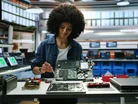
BNP Paribas, a kingpin of Europe’s financial services sector, has opened a 3,500-square-metre technology refurbishment and remarketing centre in Buchelay, France, in a bid to extend the lifespan of IT equipment and promote a circular economy.
Operated by BNP Paribas 3 Step IT, the facility is set to handle up to 400,000 IT devices annually, including those from the bank's own operations and its corporate clients across Europe.

BNP Paribas’ history in circular manufacturing
But why is BNP Paribas, a finance-focused organisation, branching into sustainable manufacturing?
The bank’s interest in circularity in tech began in 2019, when BNP Paribas teamed up with 3StepIT to kickstart a joint venture stemming from a shared ambition to lead sustainable IT lifecycle management across the continent.
Jarkko Veijalainen, Chairman of 3 Step IT, explained the rationale behind the joint venture.
“This joint venture enables us to serve our customers across Europe. We wanted a strong partner to help us spread our service concept globally,” he said at the time.
Since then, the partnership has moved from strength to strength, with the new facility in Buchelay being the latest development.
The details of the BNP Paribas’ new facility
The company’s new centre (located 45 minutes from Paris) is the manifestation of BNP Paribas’ commitment to tackling e-waste - an ever-growing problem around the world.
By refurbishing and reselling IT hardware like laptops, desktops, mobile phones, tablets and servers, the bank is aiming to drive a more sustainable IT consumption model.
Carmen Ene, CEO of BNP Paribas 3 Step IT, is a huge proponent of the principles of circularity.
“The investment in this centre underscores BNP Paribas' commitment to advancing the circular economy in Europe, aligning with the European Union's ambitious goals to promote circularity and sustainable resource use,” she says.
All in, the centre aims to process 100,000 devices by the end of 2025 before scaling up to full capacity.
Expanding sustainable IT services
The centre is not just about refurbishment; it also offers an IT Asset Disposition service, where businesses can trade in old, decommissioned equipment.
When companies hand over equipment that can’t be reused, the facility will ensure this hardware is responsibly recycled.
“This is a major step for BNP Paribas, strengthening its commitment to supporting clients in their transition to a more resource-efficient and low-carbon use of their IT assets,” explains Neil Pein, CEO of BNP Paribas Leasing Solutions.
Such services are becoming increasingly valuable as businesses seek ways to cut costs and minimise their environmental footprint.
With regulations tightening around e-waste and corporate sustainability reporting, companies are under growing pressure to adopt greener technology strategies.
Combining this new facility and its years of experience in circular initiatives, BNP Paribas has a head start on the competition.
The rise of e-waste and the demand for refurbished tech
Electronic waste (more commonly known as e-waste) is one of the fastest-growing waste streams globally, with the International Telecommunication Union estimating that 53.6 million tonnes of e-waste were generated worldwide in 2019.
Worryingly, less than 20% of this waste has been formally recycled.
The rapid turnover of IT equipment (driven by technological advancements and built-in obsolescence) exacerbates this issue.
Despite the constant turnover of IT hardware, though, the demand for refurbished technology is growing all the time.
“People are going through a kind of crisis in buying power," explains Reynold Simmonet, Co-Founder of Dipli, a French company which facilitates the refurbished market for mobile phones across Europe.
"They have less money in their bank accounts since COVID-19 and now they're not willing to spend €1,000 (US$1,046) every 24 months on a phone.”
Companies like Dipli have found huge success by offering customers warranties for refurbished technology.
This kind of guarantee reassures consumers that refurbished tech isn’t inferior tech.
Social impact and responsible employment
Beyond its many environmental benefits, the Buchelay centre is also helping BNP Paribas to integrate a responsible employment policy.
The company has pledged to support people with disabilities, individuals in social reintegration programmes and older adults through job opportunities at the facility.
“This centre also upholds a responsible employment policy, which values and supports people with disabilities, those in social reintegration and older adults,” explains Neil.
It is a project with a holistic approach to ESG, meeting a huge range of sustainable criteria.
“This marks a significant milestone for BNP Paribas 3 Step IT, reinforcing our mission to help clients maximise the value of their technology while reducing electronic waste,” Carmen says.
Explore the latest edition of Sustainability Magazine and be part of the conversation at our global conference series, Sustainability LIVE.
Discover all our upcoming events and secure your tickets today.
Sustainability Magazine is a BizClik brand