
Can Hitachi Rail Hit Carbon Neutral Goal Despite Expansion?
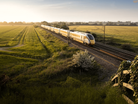
Hitachi Rail has nearly doubled its workforce in the past year thanks to its landmark acquisition of Thales Ground Transportation Systems.
One might expect such a sizeable expansion to throw any company's decarbonisation push off kilter, given the new data points it must cover, the assets it must assimilate and the new strategies it must write up.
For Hitachi's premier transport wing, though, it remains full steam ahead when it comes sustainability. In fact, the Japanese firm has reaffirmed its commitment to achieving carbon neutrality across all its business sites by 2030.
The rail manufacturer's latest sustainability report also reveals that the company will keep its commitment to being net zero by 2050, despite adding approximately 484,000 tonnes of greenhouse gases to its Scope 3 emissions baseline since the acquisition.
"We are proud to report we have achieved an important milestone to reach our carbon neutrality across our business sites in 2030 and are on track to achieve net zero emissions across our entire value chain by 2050," says Giuseppe Marino, Head of Mobility Business and Group Chief Executive.
Hitachi's manufacturing transformation is underway
The clearest evidence of this commitment comes from Hitachi Rail's manufacturing facilities, where site-level decarbonisation projects are delivering measurable results.
The company's new plant in Hagerstown, US, already operates with zero Scope 1 and 2 emissions through complete elimination of fossil fuels.
The facility features 1.8 MW of photovoltaic capacity through a power purchase agreement with Suntrail Energy, generating 2.3 GWh of green energy annually.
This installation meets approximately 60% to 70% of the plant's energy requirements and reduces emissions by an estimated 870 tonnes of CO₂ yearly.
Similar initiatives are taking shape across the company's European operations too.
In Italy, electrification of three painting booths and one oven at the Reggio Calabria site will cut out about 450 tonnes of annual Scope 1 emissions by 2026.
These efforts have contributed to an impressive waste management record, with manufacturing sites in Naples, Hagerstown and Reggio Calabria achieving zero-landfill status in FY24.
The company now diverts all waste from landfill at 97% of its manufacturing facilities.

Hitachi Rail's battery technologies
Beyond its own operations, Hitachi Rail is developing technologies to help railway operators reduce their carbon footprint.
The company completed the design phase for battery-powered train prototypes and interior components in the UK during FY24, building on experience from Italian regional tri-mode battery trains that Giuseppe noted "continue to operate daily".
The commercial viability of this technology received validation when Hitachi Rail secured its first order for 14 tri-mode intercity trains following the reporting period.
This breakthrough comes as the company participates in the EU's Rail4EARTH programme, which targets 30% CO₂ emissions reduction and 120-kilometre battery range for zero-emission trains replacing diesel units.
The development suggests battery technology is moving from experimental deployments to mainstream railway operations.
Physical and digital improvements at Hitachi
Alongside physical infrastructure improvements, Hitachi Rail is betting on digital systems to drive efficiency gains for operators.
The company launched HMAX during FY24, a digital asset management platform that creates digital twins of entire rail ecosystems including trains, signalling and infrastructure.
By enabling predictive maintenance and identifying optimal driving patterns, the system addresses the twin challenges of cost reduction and emissions management.
One customer achieved 8% energy savings using the platform, with Hitachi Rail claiming potential to reach 15% at scale.
These digital capabilities complement the company's expanded signalling expertise gained through the Thales acquisition, creating what Dr Maiya Shibasaki, the firm's CSO and Chief Diversity, Equity and Inclusion Officer, describes as a strategic advantage.
"Sustainability is not just about compliance – it's a strategic business driver that fuels innovation, strengthens competitiveness and builds long-term value," she says.
Hitachi's commitments to sustainability
The company's sustainability ambitions are increasingly embedded in its organisational structure and incentive systems.
20% of short-term incentive compensation now links directly to sustainability targets covering safety, environmental performance, diversity and employee engagement.
This financial alignment accompanies governance changes, including the appointment of an independent non-executive director to the board from FY25 to strengthen oversight.
Employee engagement levels rose by 4.9% in FY24 to reach 75.3%, supported by the establishment of 20 employee resource groups globally and a new BeWell framework targeting physical, mental and financial wellbeing.
Hitachi Rail reported total Scope 1 and Scope 2 emissions of 35,046 tonnes of CO₂ equivalent for FY24 under market-based accounting, with scope 3 emissions reaching 7.4 million tonnes.
The company has established reduction targets aligned with the Science Based Targets initiative, aiming for 75% reduction in Scope 1 and 2 emissions by 2027 against a 2019 baseline, positioning the expanded organisation to meet its 2030 carbon neutrality commitment.
Company portals

Executives

Giuseppe Marino
Head of Mobility Business and Group Chief Executive

Maiya Shibasaki
Chief Sustainability Officer and Chief Diversity, Equity & Inclusion Officer