
Crisis Ahead of COP30: We Are Past Tipping Point, Says UN

Humanity has failed to keep global heating below 1.5°C, the critical target set under the Paris Agreement.
In an exclusive interview ahead of the COP30 summit in Belém, Brazil, António Guterres, the UN Secretary-General, confirmed that there is now no chance of meeting the target.
“Let’s recognise our failure,” he says. “The truth is that we have failed to avoid an overshooting above 1.5°C in the next few years. And that going above 1.5°C has devastating consequences.”
The UN chief warned that the world is approaching irreversible tipping points in systems such as the Amazon rainforest, the Arctic and the planet’s coral reefs.
“Some of these devastating consequences are tipping points, be it in the Amazon, be it in Greenland, or western Antarctica or the coral reefs,” he adds.
Science behind the consequences
According to the Intergovernmental Panel on Climate Change (IPCC), every fraction of a degree above 1.5°C will sharply increase the risks to food security, water resources, health and biodiversity.
Extreme weather events – heatwaves, droughts and storms – will intensify, threatening millions more people and placing unparalleled strain on global systems.
Sea level rise is expected to accelerate. The difference between a 1.5°C and 2°C world translates into an extra ten centimetres of sea level rise by 2100, exposing an additional 10.4 million people to flooding and saltwater intrusion.
Vital ecosystems, such as coral reefs, face near-total destruction if warming reaches 2°C, compared with a 70-90% decline at 1.5°C. Earth is already experiencing spikes above 1.5°C and scientists warn that permanent changes will follow unless global emissions are rapidly curbed.
Tipping points: a cascade of risks
Recent research, including the Global Tipping Points Report 2025, highlights the risk of crossing critical thresholds – climate tipping points – that could accelerate irreversible changes globally.
These include the melting of polar ice sheets, the dieback of the Amazon rainforest and a breakdown of ocean circulations like the Atlantic Meridional Overturning Circulation.
Once crossed, these points can trigger cascading failures, where one system collapse hastens another, leading to further warming and widespread disruption to societies and economies.
Scientific consensus estimates that, given current emissions trajectories, there is a two-in-three chance of at least one major climate system component tipping into a radically different and largely irreversible state.
Professor Nico Wunderling, is the lead author of the tipping points report and he is deeply concerned by humanity's trajectory. "The devastating consequences that arise when climate tipping points are crossed pose a massive threat to our societies," he says.
"There is even a risk of the tipping of one climate system potentially triggering or accelerating the tipping of others. This risk increases significantly once the 1.5°C threshold is exceeded."
Pressure on leaders at COP30
COP30, set to be hosted in Brazil’s Amazonian city of Belém in a matter of weeks, will be a defining moment for governments to show whether they can change course.
Guterres called for an immediate, dramatic reduction in emissions to limit the duration and magnitude of the temperature overshoot.
“It is absolutely indispensable to change course in order to make sure that the overshoot is as short as possible and as low in intensity as possible,” he says. “We don’t want to see the Amazon as a savannah.”
However, the gap between promises and performance remains substantial.
Fewer than a third of the world’s 197 countries have submitted updated nationally determined contributions (NDCs), the emission reduction plans required under the Paris accord.
Modelling of the current pledges suggests global emissions will fall by about 10%, far below the 60% reduction needed to stay within 1.5°C.
Indigenous leadership and a just transition
One of the striking moments in the interview was António’s emphasis on Indigenous leadership in climate governance. This was his first interview with an Indigenous journalist, Wajã Xipai, representing the Sumaúma news organisation.
“It is fundamental to invest in those who are the best guardians of nature. And the best guardians of nature are precisely the Indigenous communities,” he said.
He called on world leaders to learn from Indigenous peoples about balancing human needs and ecological preservation.
“Political leaders are often more concerned with the day-to-day problems of society,” he said. “So sometimes there is no notion of the importance of a harmonious relationship with nature.”

Fossil fuels, financing and the future economy
Guterres argues that the end of the fossil fuel era is inevitable, and the shift to renewable energy is not only an environmental necessity but an economic one.
“We are seeing a renewables revolution and the transition will inevitably accelerate,” he says. “There will be no way in which humankind will be able to use all the oil and gas already discovered.”
Brazil is preparing to launch its US$125bn Tropical Forests Forever Facility, which will direct a fifth of its funds to Indigenous communities – an essential recognition that these territories contain the best-preserved biodiversity and most effective carbon sinks.
A warning and a reflection
Despite growing pressure on the multilateral system, António defended the Cop process as essential to avoiding collapse.
“The alternative is a free-for-all,” he explains. “And we know what free for all means. Free for all means that there will be a small privileged elite... as the planet is being progressively destroyed.”
With his final year as Secretary-General quickly approaching, António reflects on his tenure with humility.
“I will never give up on my commitment to climate action... to biodiversity... to the protection of nature,” he says.
Company portals

Executives
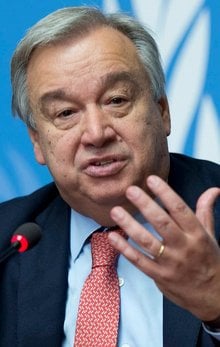
António Guterres
Secretary General