Maersk: Using Electric Trucking for Sustainable Logistics
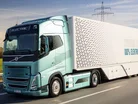
The transport and logistics industry produces almost 24% of global CO₂ emissions and consumers are calling for more sustainable options.
Business customers around the world are moving to EV trucking as the mode of choice, witnessing cost savings and emissions reductions in short periods of time.
Maersk is playing a key role in supporting this movement, exploring how to make this transition adopted on an even bigger scale.

The shift towards decarbonisation
The logistics industry ensures products can safely travel across the world. Road transport forms a significant part of this sector, yet it simultaneously represents a major contributor to greenhouse gas emissions worldwide.
In 2023, European Union fossil-fuelled road transport resulted in 750 million tonnes of carbon dioxide emissions.
This represented a 23% increase compared to 1990 figures.
Light and heavy trucks, alongside buses, accounted for 39% of these emissions.
As a leading logistics company, Maersk organises several million truck transports annually for its customers, while contributing to global pollution.
The company now faces the sustainability imperative of transforming these operations to align with climate goals.
Logistics companies are now moving to alternative solutions such as low-carbon fuels or electric fleets to decarbonise their operations.
This transition aligns with growing demand for sustainable operations, as businesses look to reduce their Scope 1, 2 and 3 emissions.
With Maersk targeting net zero emissions by 2040, the decarbonisation of road transport operations represents a critical pillar of this commitment.
From a sustainability perspective, electric trucks offer the most feasible solution for the energy transition on roads.
This assessment considers both total cost of ownership and scalability factors.
In Western countries, electric trucks cost approximately twice as much as comparable diesel products, creating a financial barrier to adoption.
Additionally, while a diesel truck requires only 10-12 minutes to refuel, EV trucks can take two to four hours to fully recharge.
However, the sustainability transition is accelerating as EV producers enter the market with more competitive models.
Furthermore, faster charging technologies are emerging, including the Megawatt Charging System (750 kW) and the Twin CCS charging solution (up to 700 kW), allowing for full charge in 30 to 45 minutes.
All sustainability, net zero and sustainable supply chain leaders should attend:
- Sustainability LIVE: The Net Zero Summit - QEII Centre, London, March 4-5
- Sustainability LIVE: The US Summit - Navy Pier, Chicago, April 21-22
Co-located with Procurement & Supply Chain LIVE, these events brings together CSOs, ESG leaders and senior decision-makers at a moment when sustainability, supply chains and commercial performance are increasingly interconnected.
Tickets can be booked online today for The Net Zero Summit and The US Summit. Group discounts available.
The environmental and efficiency case
Maersk is already deploying EV trucks for its customers across 14 countries worldwide, including China, USA, UK and Denmark.
Much of this involves cooperation with local trucking partners to identify optimal EV trucking solutions.
The company also operates its own fleets of heavy-duty EV trucks. In Germany, 25 electric Volvos serve major customers in automotive, fashion and technology sectors.
These units had covered more than 2.7 million kilometres on German highways by December 2025, while the US EV fleet had travelled 14 million kilometres.
"These figures show that we have a very important but also huge task ahead of us since Maersk has the goal to achieve net-zero emissions by 2040, which also applies to the road transport we operate for our customers," says Kenny Kristensen, Global Head of Energy Transition Business Enablement - Landside Logistics at Maersk.
"From today’s perspective, electric trucks are the best feasible solution for the energy transition on roads from both a total cost of ownership and scalability perspective – even if you still don't see electric trucks that often in many countries."
According to research from the US Department of Energy, EVs deliver superior energy efficiency compared to other options.
In EVs, 70-75% of the energy used actually powers road movement, whereas diesel combustion vehicles achieve only 25-37% efficiency.
Moreover, hydrogen-powered vehicles display energy efficiency of around 20%.
Though EV trucks carry higher initial purchase costs than alternatives, they compensate through superior energy efficiency, lower fuel costs and reduced maintenance requirements.
As businesses prioritise long-term sustainability goals alongside cost savings, the transition towards EV trucks represents not merely an environmental imperative but a strategic business decision.
Company portals

Executives
Kenny Kristensen
Global Head of Energy Transition Business Enablement - Landside Logistics