‘Maybe We Should Just Repeal All Energy Regulation?’
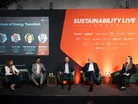
The panellists
-
Andrew Toher, Director of Energy Advisory, Enel X
- Saleh ElHattab, CEO, Gravity
- Abbie Badcock-Broe, Head of Corporate, UK & Decarbonisation Strategy, National Grid
- Tim Lord, Head of Climate and Energy, HSBC UK.
The moderator
-
Ingunn Gunnarsdottir, Leader of Innovation, ON Power.
Question 1: Why is it so critical for us to be looking ahead and what role does HSBC and the financial sector overall play in the future of the energy transition?
TIM
In terms of what HSBC and the finance sector can do, I guess three things I'd highlight very briefly. One is supporting investment, so enabling access to capital, enabling the capital to flow to where it needs to, thinking about the way that we do that because some of these projects are much more capital intensive than their fossil fuel alternatives.
Secondly, how we help clients navigate that transition, it's very complex. It's not just about energy companies, it's about the whole economy, it's about every household.
And I think the third thing is about connectivity. There are some organisations that have the privilege of working right across the economy and how do we connect the innovators to the large corporate clients? How do we connect the people needing finance to the people who might buy those products? And hopefully we can provide that finance.
ANDREW
I think we're at an interesting point in the market. We're seeing a real divergence. The regulatory environment is a significant driver and we're seeing some other divergence between what's happening in the US versus Europe. We've got this rollback from some of the legislation that supported renewables in Europe. To an extent that's happening less, so still pushing forwards. But what we see in the market is the companies that are very strategic, that are really looking long-term at staying on the path and pushing forward with their plans, maybe are just talking about it a bit less.
SALEH
Often when we talk about decarbonisation or the transition, we forget about the low-hanging fruit, energy efficiency wins. And when I think about the US alone, there's US$2tn of inefficient energy consumption every year that's literally just money wasted. And so in addition to the macro transition, which hopefully we'll all be on the right track for over the next couple of decades, there are incremental wins that each corporation can achieve.
ABBIE
We need to have much more resilient ways of being able to future proof ourselves. Our economy is built on electricity and we need to make sure that we can still grow and develop in the future. That means that it's about how we build new infrastructure, but how do we make that infrastructure work smarter for us, more efficiently, better related data, better flexibility as well, so that we can pass on savings to consumers.
Question 2:
How big a role does regulation play in this energy transition story and what can governments do to push it forward?
TIM
I think regulation plays a huge role… When we think about the rules around EV purchases in the UK, when I was in government back in 2017 or 2018, the UK said it would ban the sale of petrol and diesel vehicles by 2040. When you look at what happened with costs in the few years after that, it was moved forward to 2035 and then to 2030. So if you can make this stuff make economic and commercial sense and if you can make it a compelling consumer proposition, then it makes regulation much more straightforward.
ANDREW
I would bring it back to not trying to find that eureka solution that doesn't exist. Now we just need to figure out how to make the bulk of this work with the technologies that are there in front of us and encourage corporates to be prepared to revisit business cases – tech solutions that perhaps didn't make sense only 12 months ago start to come into focus.
ABBIE
It's really expensive to build HVDC-type cables, but we are expected from a resilience and safety perspective to always monitor them and always have a certain amount of electricity that goes through that, but it's not smart.
By putting sensors on those cables, it means that we can then see what's happening through the change of weather, the change of time, the temperatures on them, and can flow more energy through without necessarily needing to build new cables. We've done a few of those pilots ourselves, including in New York.
SALEH
One thing that's often missed when people talk about regulation is that the unsubsidised cost of solar and the unsubsidised cost of wind is more affordable than mixed gas. It's more affordable than coal, it's more affordable than all these things. But in the US we still have regulation that subsidises the fuel industries that make it competitive with them. And so for me, regulation is this funky word that often only applies to the world of sustainability. And so when we repeal it, it's bad, but if we actually repealed it all, I think economics would pan out and we'd end up seeing a lot more renewables come online.

Question 3:
What are the biggest barriers to accelerating the energy transition and is it a barrier to be operating in the US?
SALEH
More often than not, we work with corporations, not with governments. And so for me, the biggest challenge that I have to overcome is mostly cognitive. Sometimes it's literally just a bad word. The word decarbonisation in the US, depending on what state you're in, will immediately make anything you say thereafter be unheard by the recipient.
TIM
In terms of constraints, the first one is grid. I think we're making real progress, not just in the uk but more widely. It's really hard to build an electricity system on this scale while decarbonising and while fundamentally changing the nature of it. And that's clearly going to be a key constraining factor. The second is supply chains. Do we have the scale and volume in those supply chains?
A lot of those supply chains take decades to build up. And what we're trying to do here is to kind of replicate that, but in 3, 5, 10 years. But for many of these supply chains, there are fundamental differences. They need different port infrastructure, they need different financing solutions.
Question 4:
Can you give us an example of a company or a sector that has made real progress in shifting towards cleaner energy and what made it possible?
ANDREW
What I have seen to be successful is those organisations that have really pulled their sustainability, their purchasing, their finance teams together around this energy line item topic and approach it from a global perspective.
I've also seen a lot of companies that continue to manage their energy purchasing in a decentralised manner. And I think the companies that are making the most progress are following that centralised approach, doing a lot of work on stakeholder management, being prepared to bring external expertise into the organisation, collaborating with consultancies and with supply chain and defining a kind of master plan that they're prepared to continually revisit and access the projects and solutions as they become available.
SALEH
Some of the most exciting stories are that we have successfully found a number of different organisations that benefit massively from taking advantage of the fact that they aren't a grid that's very highly demanded of. And so demand response paired with battery energy and energy storage not only gets them a check from their utility provider, but allows them to use off-peak energy, which is much cleaner than the peak energy, which has to tap into these dirtier energy sources. And so we rinse and repeat. It's very replicatable. The math of it is common sense. The CFO gets really excited and somebody who may have been a naysayer before ends up being an evangelist for batteries, which is fantastic.
Company portals





Executives
Abbie Badcock-Broe
Head of Corporate, UK & Decarbonisation Strategy
Andrew Toher
Director, Energy Advisory
Ingunn Gunnarsdottir
Leader of Innovation
Tim Lord
Head of Climate Change