Why Bill Gates is Challenging Climate Orthodoxy Ahead of COP
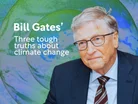
With COP30 approaching, Microsoft Co-Founder and philanthropist Bill Gates has published a controversial blog post challenging what he calls the "doomsday view" of climate change.
He argues that the climate community has become too fixated on near-term emissions goals at the expense of more effective interventions.
Writing ahead of the Brazil summit in November, Bill urges delegates to ask: "How do we make sure aid spending is delivering the greatest possible impact for the most vulnerable people?"
His answer suggests a fundamental reordering of climate priorities.

The case for climate optimism
Bill's first "tough truth" directly confronts climate catastrophism. He acknowledges that warming will reach 2°C to 3°C above pre-industrial levels by 2100, well beyond the Paris Agreement's 1.5°C target.
However, he argues this will not lead to civilisation's collapse. "Although climate change will have serious consequences – particularly for people in the poorest countries – it will not lead to humanity's demise," he writes.
He points to dramatic shifts in emissions projections. Ten years ago, the International Energy Agency forecast 50 billion tonnes of CO₂ emissions by 2040.
That figure has now dropped to 30 billion, a reduction of more than 40%. Gates attributes this to innovation driving down what he calls the "Green Premium" – the cost difference between clean and dirty technologies.
Solar, wind, power storage and EV have all gradually reached cost parity with fossil fuels.
Although climate change will have serious consequences – particularly for people in the poorest countries – it will not lead to humanity's demise.
The sustainable companies that are giving Bill Gates hope
Through Breakthrough Energy, the investment platform Bill Co-Founded in 2015, he has backed more than 150 companies working on decarbonisation. His involvement with Breakthrough has given him an insight into how the renewable energy sources of tomorrow are shaping up right now.
He points to firms like Fervo and Baseload Capital that advancing geothermal energy, while the likes of TerraPower and Commonwealth Fusion Systems are in pursuit of next-generation nuclear power.
He also alludes to the manufacturing sector, in which Boston Metal and Electra are developing zero-emissions steel, while Brimstone and Ecocem are tackling the production of low-carbon cement.
For Bill, the discovery of geologic hydrogen has been "one of the biggest energy surprises of the past decade" and he name checks Koloma, a firm that is working to extract it efficiently.
He also looks to agriculture, where he cites Pivot Bio and Windfall Bio as some of the sustainable companies that are creating fertiliser replacements with negative Green Premiums. He also mentions Rumin8 and ArkeaBio, two companies that are developing cattle feed additives that can reduce ruminant methane emissions.
The development imperative
Bill's second truth proves far more contentious. He argues that temperature is "not the best way to measure our progress on climate", which challenges the entire paradigm of net zero thinking.
Instead, he advocates a focus on the UN's Human Development Index, which measures quality of life from zero to one. Indeed, the disparities are stark. Switzerland, for example, scores 0.96 on the index while South Sudan languishes at 0.33.
To back up his argument, Bill cites research from the University of Chicago's Climate Impact Lab showing that projected climate deaths fall by more than 50% when accounting for expected economic growth in low-income countries.
"Since the economic growth that's projected for poor countries will reduce climate deaths by half, it follows that faster and more expansive growth will reduce deaths by even more," he argues.
While economic growth and a surge in living standards in developing countries is undoubtedly essential, Bill's notion here is more reminiscent of a 'business as usual' approach to sustainability and economics.
This may prove controversial with those that view the private sector and free market economics as the root of spiralling climate change.
"One hundred companies are responsible for 71% of greenhouse gas emissions," says Clover Hogan, Founder of Force of Nature. “The free market is not only the reason we're in this mess, but the single greatest barrier to solving it first."
Likewise, Kaya Axelsson, Head of Policy & Partnerships at Oxford Net Zero, says: "We confused the means for the ends. We allowed an instrument to become our own prison keeper. The market is our instrument and we must recapture it through policy and regulation."
Health and agriculture first
Bill's third truth emphasises that climate change is not the primary threat facing poor countries. This notion was recently backed up by an Ipsos survey which found that climate change is slipping down the list of concerns for many people worldwide, falling behind war and the cost of living.
He points to the eight million people that die of poverty-related health problems every year to illustrate this point.
He then contrasts this figure with climate-related fatalities, noting that excessive heat causes around 500,000 deaths annually. Conversely, excessive cold kills nearly ten times more people than that, which could be prevented if heating systems were more available and affordable worldwide.
Bill then goes on to argue that investments in health and agriculture deliver greater climate resilience than many adaptation projects.
He looks to the apps that provide AI-powered farming advice and the drought-resistant maize varieties that have increased Kenyan farmers' yields by 66% recently.
He also mentions Gavi, the vaccine-buying fund. Bill says that Gavi can save a life for little more than US$1,000, but he also says that the firm is facing a 25% funding cut over the next five years.

A strategic pivot
Bill is calling for the adoption of two priorities at COP30 and beyond. First, he wants to see the Green Premium fall to zero across all five emissions sectors. This, he argues, can be achieved through innovation and policy support.
Second, he calls for rigorous cost-benefit analysis on all climate spending based on lives saved and improved per dollar spent.
"Every effort in the world's climate agenda should undergo a similar analysis and be prioritised by its ability to save and improve lives cost-effectively," he writes.
The blog post arrives as Brazil's COP30 leadership has already signalled greater emphasis on adaptation and human development. Whether the broader climate community embraces Bill's provocative reframing of climate action remains, however, to be seen.
Many critics believe that Gates' provocative intervention will only serve to obfuscate the targets of climate action.
"Let’s be honest: this is the kind of story you tell when you’re heavily invested in the very industries driving the crisis," says Clover.
"Gates holds major stakes in coal, oil, private jets, and transport networks moving dirty fuels, which make him hundreds of millions every year.
"And billionaires like Gates are desperate to reassure us that the world will be fine because the system that is burning the planet is the same one that is lining their pockets."
Company portals



Executives
Bill Gates
Chair
Kaya Axelsson
Research and Policy Fellow (Oxford Net Zero)