How Strohm's New Gas Pipe Boosts Europe's Energy Security
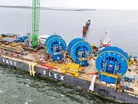
In a significant milestone for European energy security, the first gas is flowing through Strohm’s Thermoplastic Composite Pipe (TCP) system at the Wilhelmshaven 2 terminal in Germany.
It follows the successful commissioning of Excelsior, a second Floating Storage Regasification Unit (FSRU), and is the first time gas is being delivered to Europe through this newly installed subsea pipeline infrastructure.
Strohm, the world’s first and leading producer of TCP, has provided more than 11km of TCP to ECOnnect for the TES Wilhelmshaven Green Gas Terminal in Germany.
Why this low-carbon technology is ‘perfect’
Martin van Onna, Strohm’s CEO, says: “We are proud to support TES and ECOnnect Energy in delivering this critical infrastructure project and supporting Europe’s energy security.”
He adds: “Our TCP is field proven in the harshest offshore environments in the world.
“It does not corrode and it is compatible with CO2, making it perfectly suited for this project.
“Flexible and delivered in long lengths on reels in a fast-track operation, TCP’s low carbon footprint compared to steel pipe further supports both our clean energy ambitions and those of our clients.”

How will it work?
The pipeline is corrosion-resistant and lightweight and is supporting the terminal’s subsea infrastructure in what is a high-current, environmentally sensitive zone.
In phase one, the terminal will be used to import liquefied natural gas, using Strohm’s TCP, with the pipe being repurposed for liquid CO2 transport at a later stage.
Developed in close collaboration with TES, ENGIE, and DET Deutsche Energy Terminal GmbH, it is seen as a landmark achievement for Europe’s energy infrastructure, “combining cutting-edge innovation with environmental stewardship”, according to Strohm.
It adds: “The terminal’s island jetty is built approximately 1.5km from the mainland in one of the strongest currents in Europe
“The data, electricity and ultimately the natural gas pipelines are laid in the seabed for ecological reasons and connected to a head station on land.”
How will it work – part two
The gas is being transported to shore using ECOnnect Energy’s IQuay F-Class solution, which employs Strohm’s TCP to transfer the gas between the FSRU and the onshore terminal.
Strohm says: “It features Europe’s first use of ultrasound to prevent fouling in an FSRU seawater system.”
Strohm provided six 7.4-inch flowlines with a length of approximately 2km each, able to transfer natural gas and prepared for CO2.
Magnus Eikens, CCO at ECOnnect Energy, says: “This milestone marks the culmination of close collaboration and technical innovation across teams and partners.
“Together, we’ve delivered a first-of-its-kind jettyless solution using Strohm’s TCP, enabling environmentally-friendly gas transfer in one of Europe’s most challenging marine environments and laying the groundwork for future energy infrastructure.”
He adds: “Strohm’s TCP pipes are non-corrosive and compatible with CO2. This is a solution we’re eager to use again in future
projects.”
The FSRU Excelsior is expected to reach up to 4.6 billion cubic metres each over the next two years, enough to meet the annual heating needs of up to 3.7 million four-person households, Strohm says.
Explore the latest edition of Sustainability Magazine and be part of the conversation at our global conference series, Sustainability LIVE.
Discover all our upcoming events and secure your tickets today.
Sustainability Magazine is a BizClik brand