Candela’s Hydrofoil Ferry: Sustainable Travel in Stockholm
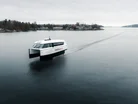
Stockholm's green transport plans are increasing to develop, including the immersion of an electric powered, hydrofoil ferry.
The Candela P-12 hydrofoil ferry, Nova, has completed its first season on public routes and the data confirms it’s not just fast and eye-catching.
Nova is efficient, well-used and pushing city transport into cleaner waters – could this be the new standard for water transport?

Candela’s electric travel
First introduced into Stockholm’s public transport system in autumn 2024, Nova returns to service after a successful run.
The ferry’s design allows it to lift above the surface while travelling – reducing drag and boosting efficiency.
With performance data being recently released, Nova shows that electric waterborne commuting isn’t some future ambition.
Nova uses hydrofoils (underwater wings) to lift its hull out of the water when travelling at speed, reducing resistance and enabling a faster, smoother ride.
The use of hydrofoils allows the ferry to cruise at 25 knots, or roughly 29 mph (46 km/h), making it the world’s fastest electric passenger vessel to date.
Its electric propulsion also means it produces a lot less emissions than its diesel counterparts.
According to the public transport authority, Nova cuts carbon dioxide emissions by 95% compared to Stockholm’s traditional ferries.
This reduction equates to 23g of CO₂ per passenger-kilometre, a fraction of the 439 grams generated by older vessels.
Nova’s energy consumption is also strikingly low, 84% less energy per passenger-kilometre.
“This feat shows that fast, electric waterborne transport over long distances is viable today, not a distant future,” comments Gustav Hasselskog, Candela’s Chief Executive Officer and Founder
Can speed and sustainability go hand in hand?
Despite Nova’s benefits, it isn’t just about cleaner air and lower emissions – it’s proving to be a commuter favourite too.
With 80% average occupancy and frequent fully booked journeys, Nova has become one of the most sought-after rides in Stockholm’s public network.
The journey between Tappström and Stockholm City Hall takes only 30 minutes, about half the time by car or bus, offering convenience and comfort.
The result is a 30% increase in ridership along Route 89, as more people choose the ferry over road travel.
Gustav Hasselskog describes this shift as a model for other cities looking to cut emissions: “High-speed, comfortable waterborne transit can actually convert car commuters into ferry riders, a holy grail for sustainable city planning.”
The surge in popularity has prompted Region Stockholm to expand the service.
Nova is set to operate six days a week starting this spring, increasing to daily trips by May.
An evaluation of the pilot programme is set for August, however Candela is already exploring options for more routes to connect the city’s expansive archipelago.
“With a relatively modest investment, charging stations could be built to fully electrify marine transport in the Stockholm archipelago,” comments Gustav Hasselskog.
“For a few hundred million euros, a charging network covering Europe’s coastal passenger transports would become a reality.”
Is Candela going global?
Candela’s success in Sweden is drawing attention abroad.
The company already has customers lined up in Saudi Arabia, New Zealand and the United States – showing international interest in low-emission, high-efficiency marine transit.
Hydrofoil ferries like the P-12 present a unique solution for cities with moderate passenger volumes where large, traditional ferries are inefficient.
The new ferries also outperform standard electric ferries by using less energy and delivering faster, more pleasant journeys.
Nova’s public trial has proven that marine electrification is not only feasible, but also desirable.
For Gustav, the path forward is clear: “We don’t have to wait for tomorrow. We have the technology to shift towards sustainable marine transport now. This is just the beginning.”
Explore the latest edition of Sustainability Magazine and be part of the conversation at our global conference series, Sustainability LIVE.
Discover all our upcoming events and secure your tickets today.
Sustainability Magazine is a BizClik brand