What Aramco, ExxonMobil & Chevron Say on Energy Transition
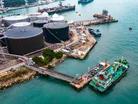
The big oil and gas companies play a significant part in polluting and warming up the planet. But they also play a critical part in driving the world's economies, vehicles, heating systems and more.
Earth cannot live with them: we cannot yet live without them.
The pressure to be green and clean has encouraged the likes of Aramco, ExxonMobil and Chevron to invest in renewable energy and make their operations more sustainable.
However, not everybody is convinced. Pressure groups are ever alert to any signs of greenwashing.
With the energy transition arguably the most crucial road on the map that leads to net zero, Sustainability Magazine sees what Aramco, ExxonMobil and Chevron are doing about it.
Read the full story in the August 2025 edition of Sustainability Magazine.
ARAMCO
Sustainability report summary
Aramco’s 4th Sustainability Report is titled Investing in Growth, Innovating for Sustainability.
Climate change and energy transition is one of the oil and gas giant’s four sustainability focus areas, alongside: safe operations and people development; Minimizing environmental impact; growing societal value.
Its mission is set out as follows: “Aramco strives to provide reliable, affordable and more sustainable energy to communities around the world and to deliver value to its shareholders through business cycles by maintaining its pre-eminence in oil and gas production and its leading position in chemicals, aiming to capture value across the energy value chain and profitably growing its portfolio.”
Amin H. Nasser, President & CEO, says: “Aramco’s vision is to be the world’s preeminent integrated energy and chemicals company, operating in a safe, sustainable and reliable manner.”
However, he is realistic about potential problems, saying: “We also recognise that there are many challenges facing our industry, including an increasingly multi-polar world as well as the realities of the global energy transition.”
So how do the mission and vision look in reality?
Targets
- Net zero Scope 1 and 2 emissions across wholly-owned operational assets by 2050
- Interim target for 2030 to reduce upstream carbon intensity to 8.6 kg CO 2e/boe
- To achieve a 15% carbon intensity reduction by 2035 compared to the 2018 baseline.
Latest figures
- Scope 1 and 2 emissions up 1.8%
- Upstream carbon intensity up 1%
- Upstream methane emissions down 11.4%
- Energy intensity up 5.9%
- Energy consumption up 2.9%.
Progress
- Agreement signed to develop a carbon capture and storage hub in Jubail, Saudi Arabia
- Purchased a 50% stake in a blue hydrogen company
- Using AI-driven analytics to monitor and reduce greenhouse gas emissions, while most of Aramco’s critical equipment is AI-monitored, with predictive algorithms helping to improve facility reliability and efficiency
- Invested US$107m in seven new companies to develop sustainable technologies
- Procured 1.1 million tons of carbon credits.
Focus ahead
- Energy Efficiency
- Flaring and Methane
- Carbon Capture and Storage
- Renewables
- Natural Climate Solutions and Offsets.
EXXONMOBIL
Sustainability report summary
Protect tomorrow. Today.
This is the headline phrase that introduces ExxonMobil’s approach to sustainability and the energy transition.
It is the company’s “guiding principle” and it adds: “It’s also a call to action. It drives us to look at our businesses with the mindset to be the most responsible operator in our industry.”
ExxonMobil’s 2024 Sustainability Report says it is working to “lead in an energy transition” that will provide solutions to support people, lower GHG emissions and manage potential impacts.
Darren Woods, Chairman & CEO, says: “We have a philosophy to be the most responsible operator in our industry. For as long as there’s a demand for oil and gas, you want the most responsible companies producing that.”
The report has to be read alongside the 2024 Advancing Climate Solutions report in order to unearth emissions data.
It says ExxonMobil is “positioned to lead in an energy transition”, but sustained reductions require a “thoughtful and comprehensive approach” that:
- Balances benefits and costs
- Is sensitive to society’s needs
- Avoids economic hardship, market disruptions and energy and product shortages.

Targets
- Net zero for Scope 1 and 2 emissions in its Permian Basin operations by 2030
- (Ambition only) Net zero for Scope 1 and 2 emissions in global operations by 2050
- Interim Scope 1 and 2 emissions reductions by 2023 of 20-30% carbon, 40-50% upstream, 70-80% methane and 60-70% flaring.
Latest figures
- Scope 1 and 2 emissions 98 million metric tons CO2e (2023 – 98 million)
- Scope 3 emissions (estimated) from crude and natural gas production 630 million tons
- Upstream carbon intensity 20.4 tons CO2e per 100 tons production (2023 – 23.7)
- Upstream energy intensity 2.1 gigajoules per metric ton production (2023 – 2.4).
Progress
- Used recycled produced, brackish or reclaimed sources to supply 98% of the water in its Permian Basin hydraulic fracturing operations in 2024
- Reduced reportable emissions of NOx, SOx and VOCs from 2016 to 2024 by 25%
- Diverted from landfill 95% of waste produced in global network of lubricants blending and packaging plants in 2023 and 2024
- Announced US$200m investment to expand advanced recycling capacity to 500 millions pounds in weight.
Levers to drive change
- Carbon capture and storage
- Hydrogen
- LNG
- Biofuels
- Lithium
- Carbon materials
- Proxxima resin systems
- Direct air capture.
CHEVRON
Sustainability report summary
Chevron’s 2024 Corporate Sustainability Highlights report says it strives to “protect the environment, empower people and get results the right way”.
It aims to grow its oil and gas business, lower the carbon intensity of its operations and grow new businesses in renewable fuels, carbon capture and offsets, hydrogen, power generation for data centres and emerging technologies.
While energy transition is only mentioned explicitly once, the report is very much about the challenges and opportunities of moving towards a new energy mix.
Writing in the 2024 Annual Report, Chairman and CEO Michael K. Wirth says: “At Chevron, we’re proud of the role we play as a global leader in energy.
“Our capabilities, assets and relationships are helping customers, industries and nations achieve their goals for economic prosperity, energy security and environmental protection.”
He said that in 2024, Chevron completed projects and operational changes designed to abate over 700,000 tonnes of carbon dioxide-equivalent annually from its operations.
Targets
- Scope 1 & 2 upstream net zero aspiration by 2050
- Scopes 1-3 carbon intensity to reduce by 5% by 2028 against 2016 baseline
- Upstream Scope 1 and 2 intensity target by 2028 against 2016 baseline: Oil down 35%; Flaring 25-30%; methane 20-25%
Latest figures
- Scope 1 and 2 GHG emissions – 57 (2023 – 55)
- Scope 3 GHG emissions in million tonnes CO2e – 940 (2023 – 871)
- Energy consumption in operated assets – 638 trillion BTUs (2023 – 632).
Progress
- Installed more than 250 facility retrofits to reduce methane emissions in Colorado, US
- Continued electrifying Permian natural gas compression stations by installing electric-driven compressors
- Installed 10-acre solar array to provide electricity for approximately 40% of the Mason City, Iowa biorefinery’s annual power needs
- Commenced preliminary front-end engineering and design for a potential hydrogen production facility in the US Gulf Coast.
Levers to drive change
- Renewable fuels
- Carbon capture and offsets
- Hydrogen
- Power generation for data centres
- Emerging technologies.
Read the full story in the August 2025 edition of Sustainability Magazine.