How PepsiCo, Coca-Cola & Starbucks Implemented Reusable Cups
PepsiCo, Coca-Cola and Starbucks are just a few of the companies that took place in a reusable cups trial in August 2024.
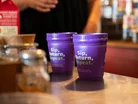
For twelve weeks, more than 30 restaurants in Petaluma, California provided purple reusable cups for takeaway drinks.
Customers returned more than 220,000 cups throughout the trial and 81% of local residents who were given a cup reported returning at least one.
The return rates exceeded the environmental “break-even” point, meaning that enough cups were returned for the system to produce environmental benefits when compared with a single use alternative.
“System change can only come with system-wide engagement and collaboration,” says Jim Andrew, Chief Sustainability Officer at PepsiCo.

“This is especially true for tackling the challenge of sustainable packaging and particularly scaling reuse solutions, which ask people to buy, consume and dispose of products in a way that may be different than how they are used to.
“This requires the creation of the necessary infrastructure to support this type of major transformation.
“It’s one of the reasons I often say sustainability is a team sport, since no single organisation can change large systems and engrained habits on its own.”
He says the pilot gave a sense “of how system change could actually happen thanks to an unprecedented collaboration.”
Jim was ranked as the number one sustainability leader in Sustainability Magazine’s Top 250 Leaders 2025 supplement.
The Petaluma project participants
The project is the result of extensive collaboration between the NextGen Consortium, the City of Petaluma, national brands, local businesses, NGOs and operational partners.
Participating locations included:
- A&W
- Dunkin’
- KFC
- Target
- Starbucks
- 7-Eleven
- Taco Bell
The NextGen Consortium, managed by Closed Loop Partners’ Centre for the Circular Economy, is a multi-year consortium with founding partners Starbucks and McDonalds.
The Coca-Cola Company and PepsiCo are sector lead partners in the consortium.
WWF is its environmental advisory partner and supporting partners include Delta Air Lines, Yum! Brands and Wendy’s.
The challenges of reuse
Managing the return, cleaning, inventory and reuse of containers is no small task.
Hundreds of thousands of cups were used throughout the trial, and each of these had to be delivered to service providers, used to serve beverages, returned, collected, washed, sanitised, inspected and repacked.
Sometimes reuse programmes can place an excessive burden on service staff who may need to take on some of these steps.
Another challenge is changing consumer behaviour – when people are so used to throwing away disposable cups, how can you break this habit to get cups returned?
Asking consumers to pay for deposits or sign up to a penalty system can incentivise returns, but it can also excuse people who may not have the disposable income, time or motivation to participate.
Reuse programmes focussed on small or closed geographical areas can help to educate consumers and achieve high return levels, but these same approaches don’t always work for everyday consumers who will travel with containers.
What did the trial show?
The Petaluma Reusable Cup Project report says that the trial “showed what’s possible when an entire community shifts to reuse as the default option for hot and cold to-go beverages”.
By using disruptive designs, such as purple cups and bins, the trial was able to make a big impact on consumer awareness.
More than 80% of Petaluma residents were aware of the programme, and 82% of consumers were aware their cup was intended to be reused.
It proved that widespread reuse is possible with large-scale collaboration – more than half of the project’s cups were successfully returned in an open system across the entire city.
Bins were placed in and outside businesses and in public areas for 24/7 access.
Robert Little, Sustainability Strategy Lead for gTech at Google, says: “This is a major milestone for the reuse movement, as it shows that reuse systems can be viable at scale - beyond say a college campus or a sporting arena.
“While there is still work to do to make reuse systems more cost-effective and convenient for businesses, the project proves that they can be successful with sufficient consumer participation.”
The project was not just extraordinarily successful, but extremely popular – 80% of participants would like the project to continue in Petaluma and 85% of customers said they were proud of the city for trying the project.
Explore the latest edition of Sustainability Magazine and be part of the conversation at our global conference series, Sustainability LIVE.
Discover all our upcoming events and secure your tickets today.
Sustainability Magazine is a BizClik brand